
Covering the business and politics of space
WASHINGTON — AST SpaceMobile executives expressed confidence in the company’s ability to field a new reusable launch vehicle in just two years despite widespread industry skepticism and conflicting accounts of where the vehicle will launch from.
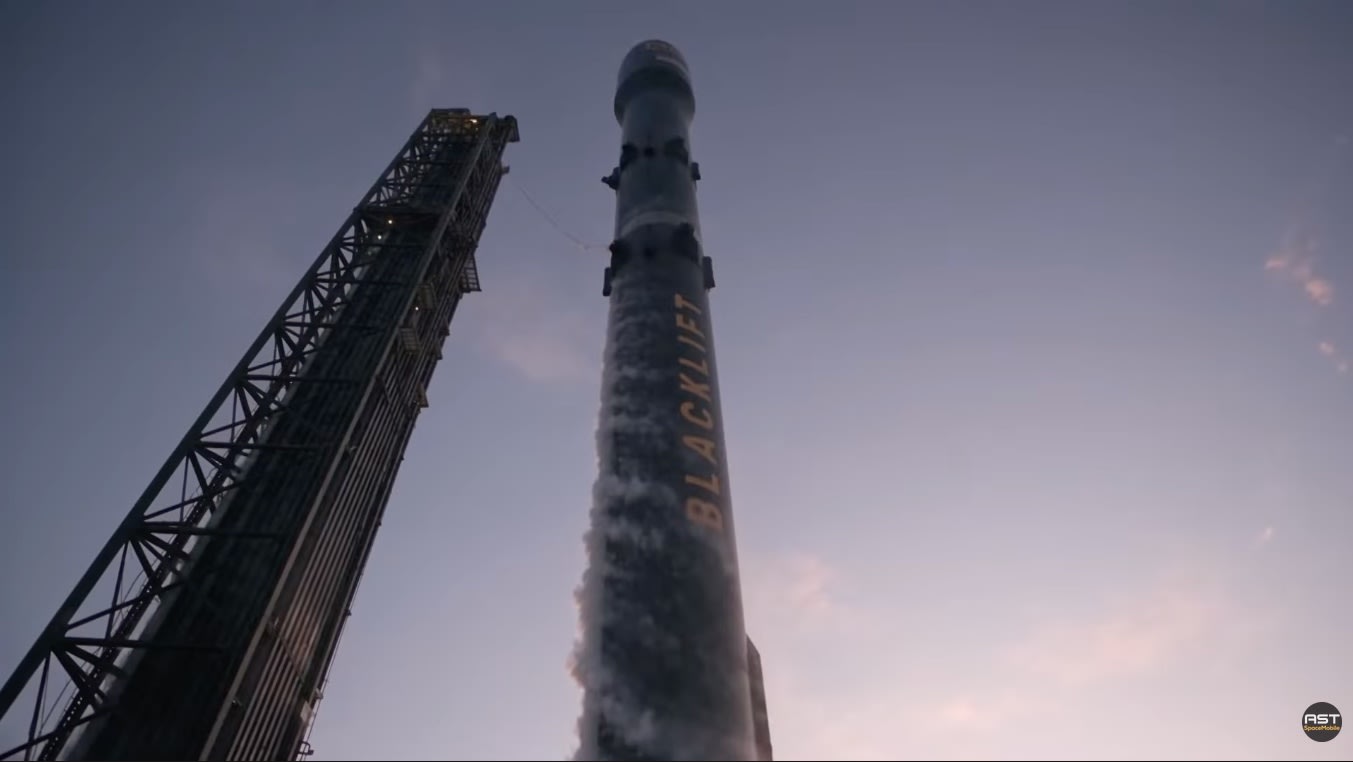
The company, which is developing a constellation of direct-to-device satellites, held an “unveiling” event in New York Nov. 12 to discuss its Blacklift launch vehicle that the company announced Nov. 6 . The company said then it was developing Blacklift to provide its own way to launch its BlueBird satellites given a constrained launch market.
“We’re not doing this thing because we want to be in the launch business. We want this because we have so much demand of our satellites and, as you have seen it, we cannot get enough launches on time,” Abel Avellan, chief executive of AST SpaceMobile, said at the event.
Blacklift, with a payload capacity of 20 tons to low Earth orbit, will be able to carry up to five BlueBird satellites per launch. The vehicle will be used exclusively for AST’s satellites, with a goal of launching twice a month.
Although the company billed the event as an unveiling, the company showed no hardware beyond videos of engines from Firefly Aerospace that AST is acquiring for Blacklift and animations of the vehicle itself. Much of the event focused on the BlueBird satellites, such as a tour of the Midland, Texas, factory where the company builds those spacecraft.
The company did provide a few technical details about the rocket. Blacklift will be a three-stage rocket, using seven of Firefly’s Miranda engines in its first stage, two Firefly Vira engines in the second stage and one Vira engine in the third stage. That is a nontraditional approach in a launch market where most vehicles optimized for low Earth orbit payloads use only two stages.
Avellan said the three-stage approach is tied to plans to recover and reuse the first stage. “When you have three stages, the first stage will go up not that much and will come back down very easily, compared of going back very high and then trying to maneuver that back to Earth,” he said. However, existing reusable rockets such as Falcon 9 and New Glenn, and those in development by Relativity Space, Rocket Lab and Stoke Space, use two-stage designs.
Blacklift will also entirely use carbon composite materials, which he said comes from the company’s experience using those materials on its spacecraft as well as Firefly’s experience from its vehicles. Composites, he said, reduce the vehicle’s dry mass by 40% compared to metallic structures.
Perhaps the most notable aspect of Blacklift is the vehicle’s schedule, which calls for a first flight in late 2028. AST argues that its decision to use Firefly engines, rather than develop its own, makes that schedule feasible.
“A typical design cycle of a rocket could be over a decade. Eighty percent of that is on the engine,” he said.
“We’re starting this program on third base,” he added. “We bypass 10 years of engineering and R&D.”
In addition to buying the engines from Firefly, AST said in its presentation it was buying other components, from avionics to separation systems, from “heritage suppliers,” although Avellan said in his talk that the company would be “95% vertically integrated” on the rocket. He said the company is starting to make composite tanks at its Midland factory using existing tools, with 10 tanks completed by January for testing.
“What remains is integration, stage testing, and licensing: exactly what the plan is built around,” the company stated in a slide.
However, it is not clear how well the company’s experience with composite structures will translate to tanks. Rocket Lab, another company using carbon composites for launch vehicle structures, had a composite propellant tank built for the first stage of its Neutron rocket damaged in qualification testing in January . In October, Rocket Lab reported another issue with the tanks , causing it to delay the vehicle’s first launch to sometime in 2027.
Another issue is where Blacklift will launch from. In a Nov. 9 earnings call, Avellan indicated that the vehicle would initially launch from the same pad at Wallops Island, Virginia, built for Northrop Grumman’s Antares and being updated to support Firefly’s Alpha and the joint Firefly/Northrop Eclipse vehicles.
“Our first launches are going to be upgrades on existing launch, which Firefly already have prearranged for their Eclipse configuration,” he said. “Wallops will require an upgrade that we can fit in the timeframe that we have.”
He provided similar comments at the unveiling event. “We have a launch site, a site which is Wallops. It’s the same place where Antares used to fly, and where the Eclipse from Firefly will fly, and that were upgrading that facility.”
“Antares heritage pad at Wallops, already being upgraded for Miranda engines,” stated a slide in AST’s presentation.
However, a spokesperson for the Virginia Spaceport Authority, which operates the commercial launch pads at Wallops, told SpaceNews Nov. 12 that while it has engaged in “early, preliminary conversations” with AST about hosting Blacklift launches, those talks do not include Pad 0-A, the pad built for Antares.
The options available to AST at Wallops include renovating Pad 0-B, which is used for smaller solid-fuel rockets, or building a new pad. Either would be significantly more expensive and time-consuming than using Pad 0-A, as AST claims it can do.
The company did not disclose how much it plans to spend developing Blacklift beyond the $1.3 billion contract with Firefly that includes engines for the first three rockets, a license to allow AST to produce its own engines and engineering services.
Jeff Foust writes about space policy, commercial space, and related topics for SpaceNews. He earned a Ph.D. in planetary sciences from the Massachusetts Institute of Technology and a bachelor’s degree with honors in geophysics and planetary science... More by Jeff Foust
Sign in by entering the code we sent to , or clicking the magic link in the email.
By creating a SpaceNews.com account, you acknowledge that you have read our privacy policy and agree to our terms and conditions. This site is protected by reCAPTCHA and the Google Privacy Policy and Terms of Service apply.
We'll send a verification code to %EMAIL% .




Loading comments…