
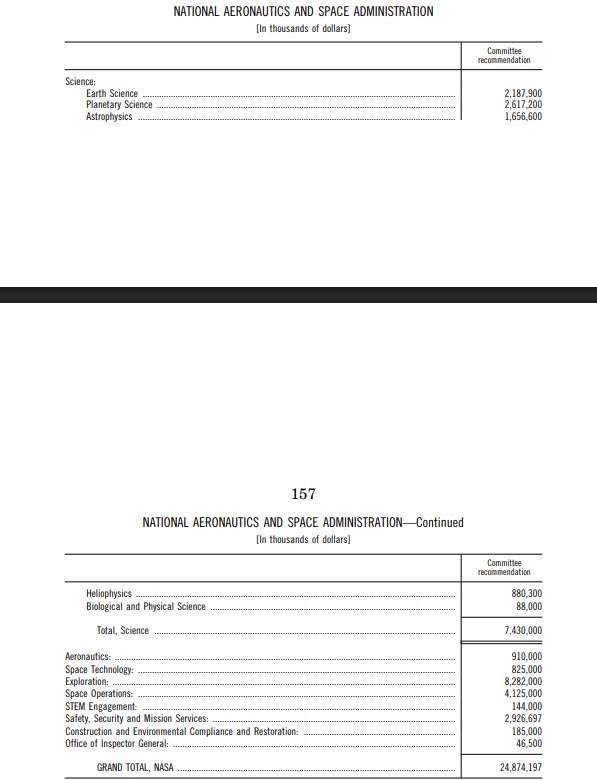
The Senate Appropriations Committee released five more FY2027 bills this evening, including the Commerce-Justice-Science bill that funds NASA. The CJS subcommittee is proposing $24.874 billion for NASA, slightly more than the $24.438 billion approved by Congress for FY2026. By contrast, the Trump Administration requested $18.8 billion in FY2027.
NASA implemented a major reorganization earlier this year, merging and/or rearranging the mission directorates and budget structure. The subcommittee’s report explains that the changes happened too late and lacked sufficient detail for them to be incorporated in this bill, however.
The text , explanatory statement , and a summary are posted on the committee’s website. The bill also funds the Department of Commerce (including NOAA), the Department of Justice, and the National Science Foundation.
Total funding for NASA, and for NASA’s science programs, are shown below.
The committee released two other bills on Tuesday. A schedule for the full committee to meet and consider the subcommittee recommendations hasn’t been announced.
The House Appropriations Committee approved its version of the CJS bill on May 13, but it has not passed the House yet. Like the Senate, it rejected the deep cuts proposed by the Administration, recommending $24.4 billion. The bill cleared the committee on a party-line vote because Democrats objected to provisions in the Commerce and Justice sections of the bill. During subcommittee markup, Democrats also opposed the level of funding for NASA’s science programs — $6 billion. While $2 billion more than the $3.9 billion requested, it is $1.3 billion less than FY2026.
The Senate subcommittee’s recommendation for science is $7.43 billion. The future of the Mars Sample Return mission to bring back the samples being collected by the Perseverance rover right now continues to be of significant interest. The subcommittee said it supports MSR “to the extent it serves as a critical strategic demonstration of the technologies, systems, and operational capabilities required for future human missions to Mars as well as to return samples for scientific inquiry.” It directs NASA to integrate MSR into the Moon-to-Mars program “as a proving ground for human exploration rather than as a standalone science mission.”
SpacePolicyOnline.com has the right (but not the obligation) to monitor the comments and to remove any materials it deems inappropriate. We do not post comments that include links to other websites since we have no control over that content nor can we verify the security of such links.


Loading comments…