About Us Advertise Careers Contact Us Privacy Policy Community Guidelines
Locating… 13°C English WhatsApp Alerts Email Alerts
BREAKING NEWS
SRI LANKA, IRELAND TO PLAY ICC WOMEN’S EMERGING NATIONS TROPHY 2026 FINAL - ICC 'SLIC' training could help engineers design analog chips faster and with less expense A LEASH for AI-controlled robots: New system could reduce harmful actions In Loving Memory of S. Sivendran (Siva) - FuneralFolio Sri Lanka rejects international probe into Chemmani mass grave - Tamil Guardian Sri Lanka Stocks Slip Again After A Surprise Rate Hike - Finimize Chinese Air Taxi Completes Sri Lanka’s First Passenger-Carrying Autonomous eVTOL Flight - autoevolution Local lattice distortion shows promise for designing self-healing alloys Eutelsat Wins $60 Million US Space Force Contract Researchers develop smarter way to handle tokens in long-context AI
TECH XPLORE

Local lattice distortion shows promise for designing self-healing alloys

Lanka Hit News • Nov 23, 2026 · 16m ago • 1 min read
Share:

Multi-principal element alloys (MPEAs) are structural materials with strong mechanical properties, good resistance to radiation damage and broad compositional flexibility. These features make them promising candidates for next-generation nuclear, aerospace and fusion applications. Their development has been hindered, however, by the cost of evaluating point-defect transport and self-healing across a vast range of compositions.

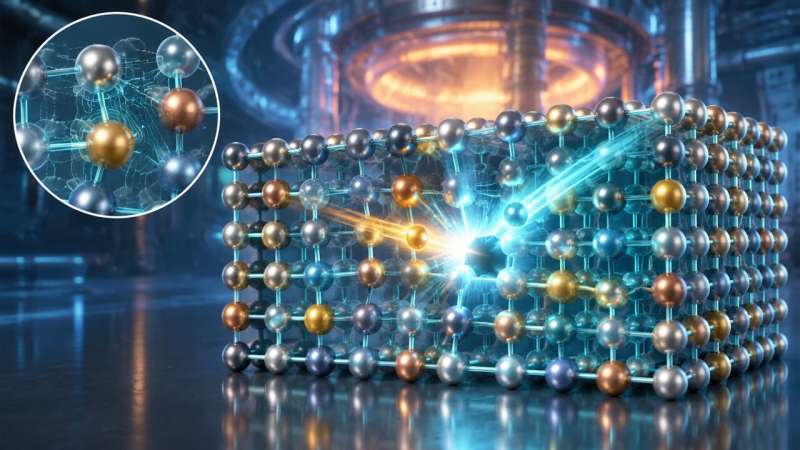
Multi-principal element alloys (MPEAs) are structural materials with strong mechanical properties, good resistance to radiation damage and broad compositional flexibility.

These features make them promising candidates for next-generation nuclear, aerospace and fusion applications.

Their development has been hindered, however, by the cost of evaluating point-defect transport and self-healing across a vast range of compositions.

Join the Conversation