
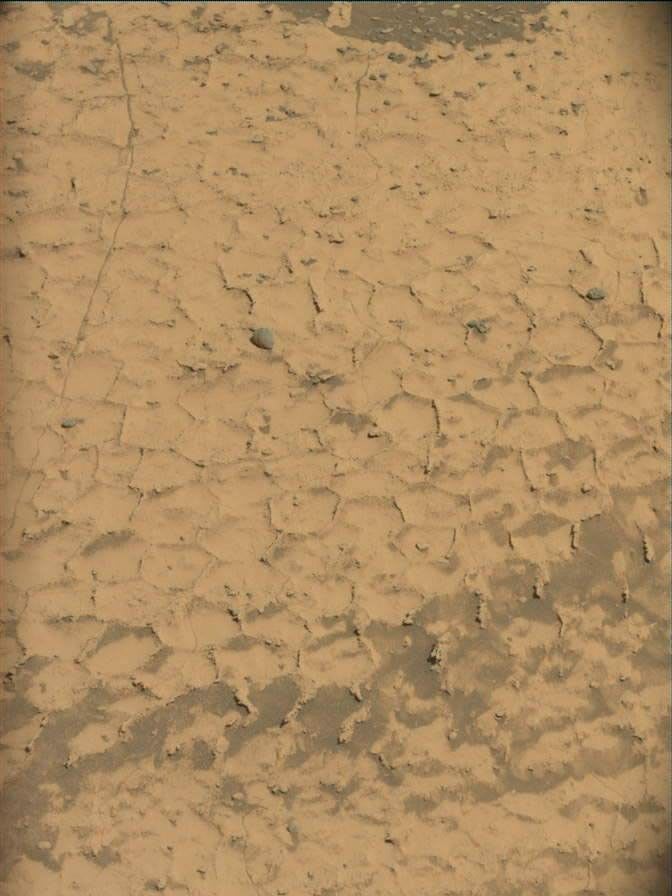
Mars Science Laboratory Mission Team Members
Written by Abigail Fraeman, Deputy Project Scientist, Jet Propulsion Laboratory, California Institute of Technology
Earth planning date: Friday, Nov. 13, 2026
Curiosity’s past several weeks have been very focused on drilling and analysis of the “Basque Lakes” and “Nazca” samples. We learned a lot from those drilled samples, but it’s time to hit the Martian road again and resume our climb up Mount Sharp. The Yardang unit on the upper part of the mountain is calling! As we climb higher on Mount Sharp, we’ll continue to use many of our less resource intensive science instruments like APXS, ChemCam, MAHLI, and Mastcam to document the chemistry and textures of the rocks we encounter while making purposeful upward progress. These measurements allow us to document changes in the environments that formed the rocks and that altered them over time.
The two areas we explored this week had rocks that were crisscrossed by lots of small, regular sized polygons surrounded by raised ridges. This texture was very similar to the rocks we encountered a few months ago slightly lower on the mountain . Those unique textures really surprised us when we first saw them, and we’ve been spending time as a science team discussing how they may have formed. Polygonal textures like these can form under a variety of different conditions including shrinkage of the surface when water is lost from minerals, temperature cycling, or compaction and expansion after being buried and exposed. The data Curiosity collected this week give us more clues about the genesis of these features and what they reveal about the evolution of Mars’ habitability. We’ll also get information about the composition of the cements that form the raised ridges around the polygons.
In the orbital view of our future route, I can see the layers that we’ll reach next week or the week after have textures very similar to where we first saw the amazing field of polygons. So I’m guessing we’ll continue to encounter polygons in the next couple drives, and that they’ll look more dramatic and expansive with each drive. But this is just a guess! After over 5,000 sols of exploring with Curiosity I’ve learned Mars is full of surprises, so I’m really looking forward to seeing what’s up ahead in the new future and testing if my guess is correct.
Mars is the fourth planet from the Sun, and the seventh largest. It’s the only planet we know of inhabited…
Explore this collection of Mars images, videos, resources, PDFs, and toolkits. Discover valuable content designed to inform, educate, and inspire,…
Each robotic explorer sent to the Red Planet has its own unique capabilities driven by science. Many attributes of a…
The key to understanding the past, present or future potential for life on Mars can be found in NASA’s four…
NASA explores the unknown in air and space, innovates for the benefit of humanity, and inspires the world through discovery.

Loading comments…