
About Us Advertise Careers Contact Us Privacy Policy Community Guidelines
Locating… 13°C English WhatsApp Alerts Email Alerts
BREAKING NEWS
Perseverance Update: The Ghostly Rocks of ‘Idubi’ — Bright Remnants of Aqueous Systems from Long Ago A Collage Showing 49 Drill Holes Made by NASA’s Curiosity Mars Rover Launch Preview: Ariane 6 to launch Amazon satellites, Falcon 9 to launch government missions NASA Receives 16th Consecutive ‘Clean’ Financial Audit Opinion SpaceNukes Opens Los Alamos Manufacture and Materials Facility to Build Its Next-Generation Space Reactor When will humans actually fly on Starship? Sinopec Demands Derail Oil Refinery Plans at Sri Lanka’s Hambantota - The Diplomat – Asia-Pacific Current Affairs Magazine APOD: 2026 November 17 – Milky Way versus Aurora Tossing Fireworks from Cloud to Cloud Pakistan wins toss, elects to bowl in 2nd cricket test against Sri Lanka - Madison Courier
SPACEFLIGHT

APOD: 2026 November 17 – Milky Way versus Aurora

Lanka Hit News • Nov 17, 2026 · 1h ago • 1 min read
Share:

APOD Science APOD APOD: 2026 November 17 –… Today’s APOD Archive Submissions Index Search Calendar RSS Education About Discuss   APOD Astronomy Picture of the Day Discover the cosmos! Each day a different image or photograph of our fascinating universe is featured, along with a brief explanation written by a professional astronomer. OriginalAnnotated Milky Way […]

Discover the cosmos! Each day a different image or photograph of our fascinating universe is featured, along with a brief explanation written by a professional astronomer.

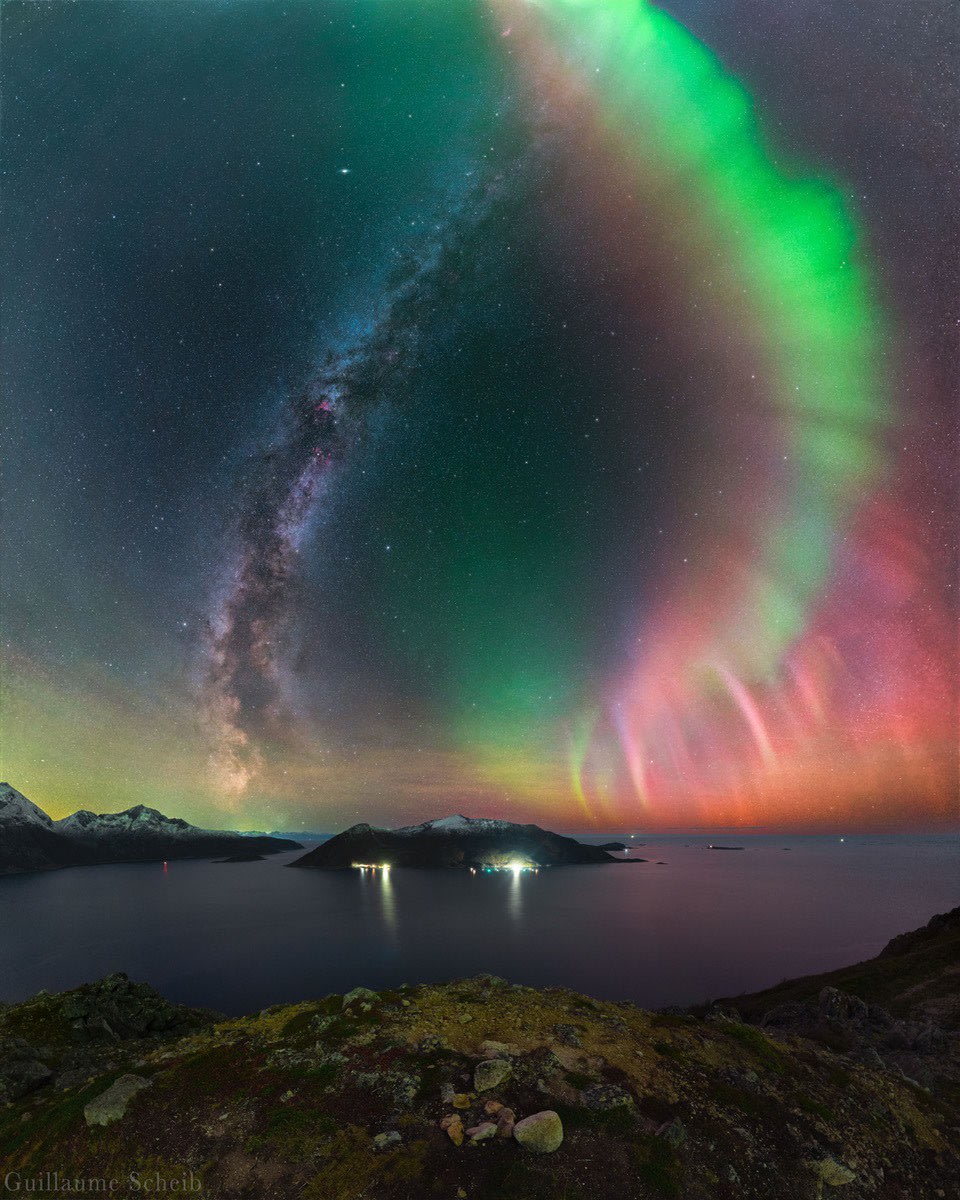
Explanation: Are these two giant arches battling for control of the sky? No, but it sure looks like it! The arch on the left is the central band of our Milky Way Galaxy , an ancient system of stars, gas, and dust that predates our Earth and is very far away. The arch on the right, by contrast, is an auroral ribbon that is only hours old, composed of energized atoms and molecules , and is close by -- right in Earth's upper atmosphere . These chance-superposed titan s have our Sun in common, a stellar member of the Milky Way that ejects energetic particles which create aurora s. Far behind the middle of the auroral arch is the Big Dipper . Even farther in the distance is the Andromeda galaxy -- the bright spot near the top of the frame, just left of center. The featured image was taken about a month ago from Kvaløya in northern Norway . Tomorrow's picture: open space

NASA explores the unknown in air and space, innovates for the benefit of humanity, and inspires the world through discovery.

Join the Conversation