
Thank you for visiting nature.com. You are using a browser version with limited support for CSS. To obtain the best experience, we recommend you use a more up to date browser (or turn off compatibility mode in Internet Explorer). In the meantime, to ensure continued support, we are displaying the site without styles and JavaScript.
Nature Medicine ( 2026 ) Cite this article
Despite long-standing immunization programs, pertussis remains a major cause of vaccine-preventable mortality, particularly among infants. Here we present a primary assessment of global pertussis incidence, mortality and disability-adjusted life years across 204 countries and territories from 1990 to 2023. We show that despite short-term pandemic-period fluctuations, the dominant global pattern from 1990 to 2023 was long-term decline: age-standardized mortality decreased by 61.2% and age-standardized incidence by 41.6%. Relative to the anomalously low pandemic-period estimates, incidence and mortality rebounded by 102.6% (95% uncertainty interval, 77.0–128.2%) and 66.1% (95% uncertainty interval, 2.4–174.5%), respectively, between 2020 and 2023. In 2023 alone, we estimated 18.9 million cases and 115,000 deaths attributable to pertussis. This burden remains profoundly inequitable and inversely correlated with the sociodemographic index; sub-Saharan Africa now accounts for roughly 65% of global deaths, with the highest population-adjusted risk concentrated among infants younger than 6 months. Our findings highlight a modeled geographic concentration of pertussis mortality and support strengthening timely infant vaccination, maternal immunization where recommended and feasible and robust surveillance in highly susceptible regions.
Bordetella pertussis , the causative agent of pertussis (whooping cough), is a highly contagious respiratory bacterial pathogen with important global health implications. Before the introduction of effective vaccines, pertussis was a leading cause of childhood mortality worldwide, responsible for hundreds of thousands of deaths annually, particularly among infants and young children 1 , 2 , 3 , 4 . Despite the widespread implementation of vaccination programs, pertussis continues to be one of the most important causes of vaccine-preventable deaths in children. While a previous study 1 reported 24.1 million cases and 160,700 deaths in children under 5 years of age as of 2014, the burden remains disproportionately concentrated in low- and middle-income countries 2 , 5 , 6 . The disease poses a severe threat especially to infants, who are not only too young to be fully vaccinated, but also physiologically more vulnerable to severe and life-threatening complications 7 , 8 .
Since the advent of whole-cell pertussis vaccines in the 1940s and the global expansion of immunization programs in the 1970s, there has been a dramatic reduction in pertussis-related mortality and morbidity 1 , 2 , 3 , 4 . However, persistent transmission remains a challenge. In recent decades, several high-income countries have experienced a resurgence or plateauing of pertussis incidence, while low-income regions continue to bear a disproportionate burden of disease 2 , 5 , 6 , 9 , 10 , 11 , 12 . In some well-resourced settings, external evidence suggests that waning immunity after acellular pertussis vaccination, differences between whole-cell pertussis and acellular pertussis vaccine-induced protection, and changes in surveillance and diagnostic intensity may contribute to persistent or recurrent pertussis incidence 9 , 11 , 13 , 14 , 15 , 16 . Furthermore, recent evidence highlights pathogen adaptation—such as the emergence of pertactin-deficient and macrolide-resistant B. pertussis strains—which may further undermine vaccine-induced protection 17 , 18 , 19 , 20 , 21 . Conversely, in settings with a low sociodemographic index (SDI), incomplete vaccine coverage, limited surveillance capacity and structural inequities in healthcare access remain the primary barriers to control 10 , 11 , 12 , 22 , 23 , 24 , 25 .
These existing challenges were profoundly compounded by the coronavirus disease 2019 (COVID-19) pandemic, which created unprecedented disruptions to routine immunization services and surveillance systems 9 , 26 , 27 . During the acute pandemic phase, changes in contact patterns, mitigation measures, healthcare seeking, diagnostic testing and reporting systems coincided with marked reductions in detected respiratory infections, including pertussis 28 . Decreased third-dose diphtheria–tetanus–pertussis (DTP3) vaccine coverage and reduced natural immune boosting may also have increased population susceptibility, although their relative contributions cannot be separated in the present analysis 9 , 29 . As pandemic restrictions eased, this accumulation of susceptible individuals was associated with a rebound in reported pertussis activity in multiple regions 28 . Previous global studies, including earlier iterations of the Global Burden of Diseases, Injuries, and Risk Factors Study (GBD) 30 , have provided valuable epidemiologic insights but could not fully capture pandemic-period suppression and the early post-pandemic rebound now observed through 2023 (ref. 31 ).
This study used GBD 2023 estimates to assess pertussis incidence, mortality and disability-adjusted life years (DALYs) from 1990 to 2023 across 204 countries and territories. We aimed to characterize long-term and pandemic-period temporal trends, geographic and sociodemographic inequalities, and age-specific and sex-specific patterns in disease burden, with particular attention to the burden among young infants.
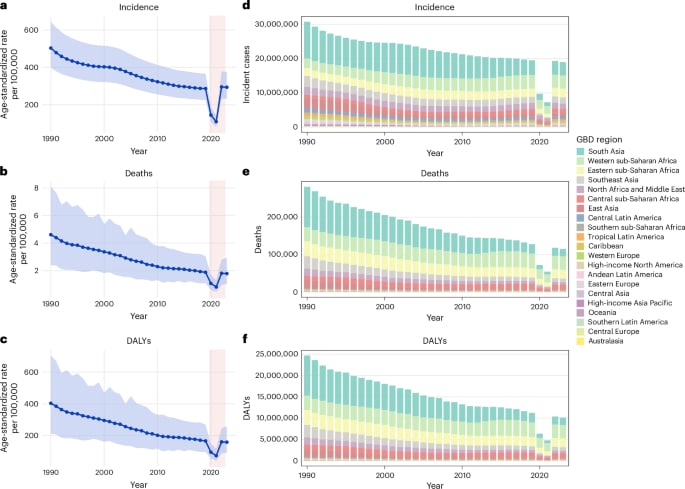
Between 1990 and 2023, the dominant global pattern was a substantial long-term decline in pertussis burden. The global age-standardized mortality rate (ASMR) decreased from 4.61 per 100,000 in 1990 to 1.79 per 100,000 in 2023, representing a 61.2% reduction. The global age-standardized incidence rate (ASIR) also declined by 41.6% over the same period. In 2023, GBD estimated 18,955,648 incident cases (95% uncertainty interval (UI), 14,956,386–24,270,133) and 115,242 deaths (95% UI, 66,577–189,183). To contextualize the post-pandemic period, we compared 2023 estimates directly with the 2019 pre-pandemic baseline. The global ASIR in 2023 was 293.7 per 100,000 (95% UI 231.8–376.1), broadly comparable to 286.4 per 100,000 (95% UI 226.0–366.5) in 2019. Similarly, the global ASMR in 2023 was 1.79 per 100,000 (95% UI 1.03–2.94), slightly below the 2019 estimate of 1.88 per 100,000 (95% UI 1.09–3.05). These comparisons indicate a return toward pre-pandemic baseline levels rather than an unprecedented global surge by 2023. Relative to the anomalously low pandemic-period estimates, incidence increased by 102.6% (95% UI 77.0–128.2%) and mortality by 66.1% (95% UI 2.4–174.5%) between 2020 and 2023 (Fig. 1a–c and Table 1 ).
a , Global ASIR per 100,000 population. b , Global ASMR per 100,000 population. c , Global ASDR per 100,000 population. Solid lines show GBD 2023 point estimates, defined as the means of 1,000 draws; blue shaded areas show 95% UIs, defined by the 2.5th and 97.5th percentiles of the draws. The pink vertical band indicates 2019–2022, the period spanning the COVID-19 pandemic and associated disruption to routine services and surveillance. d , Absolute number of incident cases by GBD region. e , Absolute number of deaths by GBD region. f , Absolute number of DALYs by GBD region. Stacked-bar heights show GBD 2023 point estimates (means of 1,000 draws) for all ages and both sexes; colors indicate the contribution of each GBD region.
Regionally, East Asia achieved the largest reductions, with ASMRs and ASIRs declining by 91.2% (95% UI 35.0–98.3%) and 60.3% (95% UI 57.1–62.8%), respectively. Tropical Latin America also showed a reduction, with a 70.7% (95% UI 10.9–95.2%) decline in ASMRs. In contrast, Oceania experienced the largest increases in absolute numbers—deaths and cases rose by 57.8% and 116.2%, respectively—although its ASMR exhibited a nonsignificant change (–20.5%, 95% UI –87.0% to 295.9%). The wide UIs observed in regions such as Oceania are indicative of data scarcity in smaller populations. Similarly, trends in Southern sub-Saharan Africa showed stagnation, with a nonsignificant change in ASMR (–12.5%, 95% UI –77.6% to 188.8%; Supplementary Tables 2 – 6 ). At the country level, 36 (17.6%) of 204 countries showed an increased incidence pattern from 1990 to 2023. For example, the incidence rate in the United States increased from 48.8 (95% UI 36.6 to 63.4) per 100,000 in 1990 to 126.7 (95% UI 98.4 to 161.1) per 100,000 in 2023, with ASIR rising by 158.6% (95% UI 139.6–178.8; Supplementary Table 7 ).
In a descriptive comparison with public World Health Organization (WHO)/United Nations Children’s Fund (UNICEF) JRF surveillance data, 200 of 204 GBD country or territory locations were matched to WHO/JRF country codes, and 2023 reported incidence data were available for 162 matched locations (Supplementary Table 8 and Extended Data Fig. 1a ). Country-level concordance in all-age incidence rates was limited (Pearson r = −0.103; Spearman ρ = −0.180). Among the 116 locations with positive case counts in both sources, the log-scale Pearson and Spearman correlations were 0.398 and 0.348, respectively (Extended Data Fig. 1b ). Across the 166 locations with available WHO/JRF 2024 data, the Spearman correlation between GBD 2023 estimated case ranks and WHO/JRF 2024 notification ranks was 0.314, and China was the only location included in both top-ten lists (Supplementary Table 8 ). WHO/JRF recorded 163,454 reported cases among matched locations with available data in 2023, whereas GBD 2023 estimated 18.9 million cases across all 204 locations. These quantities are not directly comparable because WHO/JRF data represent reported cases, whereas GBD estimates aim to approximate underlying incidence after modeling and adjustment for incomplete ascertainment. In the WHO public summary, reported cases increased globally from 163,388 in 2023 to 941,582 in 2024 (5.76-fold), with the largest regional increase in the Western Pacific region, from 49,406 to 593,659 cases (12.0-fold; Supplementary Table 9 and Extended Data Fig. 1c ). China had the largest reported national increase, from 41,124 cases in 2023 to 476,690 in 2024 (Supplementary Table 8 ).
In 2023, geographic disparities persisted, characterized by a shift in burden concentration. In the GBD modeled estimates, sub-Saharan Africa had the largest share of global pertussis mortality and DALYs, accounting for 63–65% of global pertussis deaths and DALYs—a substantial increase from its ~30% share in 1990. This growing proportional share primarily reflects slower rates of decline compared to other regions, rather than an absolute increase in regional mortality. The region recorded an ASMR of 4.18 per 100,000 (95% UI 2.20–7.60) in 2023. At the national level, Nigeria (ASMR 4.99 per 100,000, 95% UI: 0.47–14.23) and the Democratic Republic of the Congo (ASMR 5.19 per 100,000, 95% UI: 0.60–15.53) exemplified this severity. Longitudinal analysis indicates that estimated mortality reductions in these countries between 1990 and 2023 (–49.2% and –51.5%, respectively) were not statistically significant, with wide UIs crossing zero (Fig. 2 ).
a , ASIR per 100,000 population in 2023. b , ASMR per 100,000 population in 2023. c , ASDR per 100,000 population in 2023. Colors indicate discrete categories of the GBD 2023 point estimates; gray indicates locations without an estimate. Insets show the Caribbean and Central America, Balkan Peninsula, Northern Europe, Persian Gulf, Southeast Asia, West Africa and Eastern Mediterranean to improve visibility of small geographic areas. Basemap from GADM ( https://gadm.org/ ) under a Creative Commons license CC BY‑SA 2.0 . All maps were generated by the authors.
South Asia, which dominated the global burden in 1990 with approximately 38% of deaths and DALYs, saw its share decline to approximately 17% for deaths and DALYs, while accounting for 21% of global incidence by 2023. The region recorded an estimated 3.91 million cases and 19,852 deaths in 2023. India achieved a significant 85.1% (95% UI 33.2–98.2%) reduction in ASMR. However, heterogeneity exists; Pakistan showed a nonsignificant mortality reduction of 68.3% (95% UI –222.7% to 96.1%). For incidence, the shift in contribution was more moderate than for mortality: South Asia (20.6%) and Western sub-Saharan Africa (20.3%) showed comparable contributions to the global case count in 2023.
By comparison, East Asia and Central Asia maintained extremely low burdens; for instance, China had an estimated ASMR of 0.13 per 100,000 following a 92.4% decline, and Kyrgyzstan achieved a near-total reduction (–99.9%). High-income regions maintained consistently minimal burdens, contributing less than 5% to global deaths throughout the study period (Fig. 1d–f ).
Age remains a major determinant of risk, with the highest population-adjusted mortality rates consistently observed in early infancy. In 2023, the distribution of pertussis burden varied depending on whether absolute numbers or population-adjusted rates were examined, highlighting the crucial distinction between the aggregate number of fatalities within an age cohort and the actual individual risk of death. While the highest absolute number of deaths occurred in children aged 2–4 years (25,954, 95% UI 14,786–43,587), the risk of death was highest in early infancy. The mortality rate for infants aged 1–5 months was 45.7 per 100,000 (95% UI 26.0–79.0)—more than double that of the 12–23-month group (19.6) and nearly triple that of the 2–4-year group (6.61). This intense risk concentration in early infancy represents a marked improvement from 1990, when mortality rates in the 1–5-month group were 108.1 per 100,000. Incidence rates followed a similar age-dependent gradient, peaking in the 1–5-month group. Notably, sex differences in both mortality and incidence rates were minimal, with largely overlapping 95% UIs between females and males across all age groups, indicating that age—rather than sex—is the primary determinant of pertussis risk (Fig. 3 ).
a , Estimated number of incident cases by age group. b , Estimated number of deaths by age group. c , Estimated number of DALYs by age group. d , Incidence rate per 100,000 population by age group. e , Mortality rate per 100,000 population by age group. f , DALY rate per 100,000 population by age group. Orange bars show estimates for 1990, and blue bars show estimates for 2023; bar direction is used only to distinguish years and does not indicate negative values. Bars show GBD 2023 point estimates, defined as the means of 1,000 draws; horizontal error bars show 95% UIs, defined by the 2.5th and 97.5th percentiles of the draws. Estimates are for both sexes globally.
Temporal improvements in pertussis burden varied markedly by region (Extended Data Figs. 2 – 8 ). For mortality, high-income regions achieved the steepest declines, with rates in the vulnerable 1–5-month age group dropping by 93.7% (95% UI 76.8–97.7%) to near-elimination levels of 0.20 per 100,000 (95% UI 0.11–0.33). South Asia also achieved rapid declines, with rates falling by 77.3% (95% UI 0.5–94.8%) to 36.8 per 100,000. In contrast, sub-Saharan Africa showed the slowest progress; although the mortality rate in this age group declined by 58.1% (95% UI 19.9–76.6%), it remained exceptionally high at 92.1 per 100,000 (95% UI 50.7–157.3) in 2023.
Unlike the stark disparities in mortality, reductions in incidence rates were less disparate. High-income regions saw declines of approximately 39–42% across childhood age groups, similar to global averages. Furthermore, despite regional differences in magnitude, the relative age profile remained consistent: infants under 6 months consistently faced the highest population-adjusted risk across all regions and time periods.
A post hoc comparison of recent age-specific mortality patterns showed that the global mortality rate among infants aged 1–5 months was similar in 2019 and 2023 (45.47 and 45.73 per 100,000, respectively), with the lowest rate during 2019–2023 occurring in 2021. This suggests that the increase observed from the pandemic-period trough to 2023 primarily reflected rebound from an unusually low pandemic-period estimate, rather than a marked worsening beyond the 2019 baseline. Regional patterns varied and are summarized in Supplementary Table 13 and Extended Data Fig. 9b .
In a descriptive post hoc analysis of the high-income super-region, incidence rates in the available broad age groups among people aged 5 years and older were 4.6–5.8% higher in 2023 than in 2019, while the share of cases in children aged 5–9 years changed from 60.30% to 59.77%. These results did not provide evidence of a marked shift in the age structure toward adolescents or adults.
At the national level in 2023, SDI was negatively correlated with age-standardized pertussis burden. Unweighted Pearson correlation coefficients between SDI and ASMR, ASIR and age-standardized DALY rate (ASDR) were −0.732, −0.584 and −0.732, respectively (all P < 0.001). Spearman correlations showed similar patterns for ASMR (−0.796), ASIR (−0.578) and ASDR (−0.809). Countries with lower SDI generally had higher modeled mortality and DALY rates, although substantial heterogeneity was observed among countries with similar SDI values (Fig. 4 ). Because mortality estimates in some high-SDI countries were close to zero, fold-difference comparisons based on extreme country pairs were not emphasized.
a , Association between SDI and the ASMR. b , Association between SDI and the ASIR. c , Association between SDI and ASDR. Each point represents one country or territory ( n = 204) and shows the GBD 2023 point estimate, defined as the mean of 1,000 draws. Red curves show values fitted using locally estimated scatterplot smoothing (LOESS); shaded areas show pointwise 95% confidence bands around the fitted curves, calculated from the standard errors of the LOESS fits. Associations were assessed using two-sided Pearson product–moment correlation tests and two-sided Spearman rank correlation tests. For mortality, Pearson r = −0.732 (95% confidence interval (CI), −0.790 to −0.661; d.f. = 202; P = 1.60 × 10 −35 ) and Spearman ρ = −0.796 ( P = 6.90 × 10 −46 ). For incidence, Pearson r = −0.584 (95% CI, −0.667 to −0.485; d.f. = 202; P = 5.21 × 10 −20 ) and Spearman ρ = −0.578 ( P = 1.39 × 10 −19 ). For DALYs, Pearson r = −0.732 (95% CI, −0.790 to −0.661; d.f. = 202; P = 1.79 × 10 −35 ) and Spearman ρ = −0.809 ( P = 1.83 × 10 −48 ). No adjustment was made for multiple comparisons because these country-level analyses were descriptive. The LOESS curves and confidence bands are descriptive and were not used for hypothesis testing.
This study provides a global assessment of age-specific, sex-specific and location-specific patterns in pertussis burden from 1990 to 2023. The dominant long-term pattern was a decline in age-standardized mortality and incidence, but this progress was uneven. Modeled mortality remained concentrated in sub-Saharan Africa, whereas several high-income settings had persistent or recurrent incidence despite low mortality. The greatest population-adjusted mortality risk occurred among infants before completion of the primary series. Together, these patterns indicate that pertussis control requires different, but complementary, priorities across settings: equitable routine immunization and access to care where mortality is highest, and sustained surveillance and prevention of recurrent transmission where notification systems are strong 1 , 2 , 6 .
These findings place pertussis within a wider challenge for vaccine-preventable diseases. Progress against diseases such as measles, poliomyelitis, tetanus and pertussis depends on sustained delivery of routine vaccination, equitable access to primary care and the capacity to identify and respond to immunity gaps 32 , 33 . Pertussis should nevertheless not be interpreted through a single template. Its age distribution, waning vaccine-derived protection, diagnostic practices and incomplete case ascertainment differ from those of other vaccine-preventable diseases. Measles can rapidly expose population immunity gaps because of its very high transmissibility, whereas pertussis may remain under-detected in adolescents and adults while causing its most severe outcomes in young infants 9 , 11 , 16 . These distinctions support disease-specific surveillance and prevention strategies within integrated immunization programs rather than a uniform response to all vaccine-preventable diseases.
The regional distribution of modeled mortality highlights the importance of strengthening routine immunization in settings with the greatest unmet need. The growing share of global mortality in sub-Saharan Africa reflects slower reductions than in many other regions rather than an observed increase in deaths. This pattern is consistent with the combined effects of gaps in vaccination coverage and timeliness, limited diagnostic and surveillance capacity, barriers to healthcare access, and disruption associated with conflict or fragile health systems 6 , 34 , 35 . These factors cannot be disentangled by the present analysis. Nevertheless, practical priorities include dependable vaccine supply, outreach to underserved populations, timely completion of infant doses, and use of subnational coverage and disease data to identify children who are unvaccinated or delayed. Catch-up activities can help restore protection after disruption but should reinforce rather than replace routine primary healthcare.
The infant findings have direct implications for prevention. The global mortality rate among infants aged 1–5 months was similar in 2019 and 2023, and the 2023 rate was at or below the corresponding 2019 level in four of the seven GBD super-regions. This pattern is consistent with resilience of infant immunization services; however, these modeled descriptive trends cannot establish a causal effect of vaccination programs or continuity of immunization services. Severe outcomes remain concentrated in the period before infants complete their primary vaccination series, when protection depends on timely infant doses, maternal antibodies and reduced exposure to infection. Maternal pertussis immunization, where recommended and feasible within national programs, can help bridge this interval and should be considered alongside high-quality antenatal care, prompt recognition of severe infant illness and effective referral pathways 7 , 26 , 36 , 37 , 38 , 39 , 40 , 41 , 42 . These measures should complement routine childhood vaccination, not compete with it. Although the findings support prioritizing this age group, they do not establish the effectiveness of any individual maternal immunization or infant vaccination program in a particular setting.
In high-income settings, persistent or recurrent incidence after the acute phase of the COVID-19 pandemic warrants continued attention. In the available broad age groups, the post hoc analysis did not indicate a marked shift in incidence toward adolescents or adults between 2019 and 2023. The absence of harmonized country-level information on vaccine formulation, transition timing and booster schedules precluded attributing the observed pattern to acellular rather than whole-cell vaccines. Observed trends may reflect a combination of changes in contact patterns, healthcare seeking, laboratory testing, reporting, population immunity and circulating strains 9 , 11 , 21 . Waning protection after acellular vaccination, changes in booster policies, maternal immunization, pathogen adaptation and antimicrobial resistance are plausible contributors, but the present analysis was not designed to estimate their separate effects. Policies should therefore combine age-appropriate vaccination recommendations with high-quality laboratory confirmation, complete reporting and investigation of severe disease, rather than attribute observed trends to a single vaccine product or mechanism 11 , 16 , 43 , 44 , 45 , 46 , 47 , 48 , 49 .
The post-pandemic context reinforces the value of surveillance, but it also requires careful interpretation. Compared with the unusually low pandemic-period estimates, 2023 burden increased; comparison with the pre-pandemic 2019 baseline, however, suggests a return toward earlier levels rather than evidence of an unprecedented global surge. The GBD 2023 estimates end in 2023 and do not quantify the subsequent reported waves. Public WHO/UNICEF JRF notifications are important for detecting outbreaks and guiding action, but they are not directly equivalent to modeled underlying incidence and should not be used as formal validation targets 50 . More informative surveillance would routinely capture age, vaccination history, laboratory confirmation, hospitalization and outcome, and link these data to local coverage indicators.
This study has several limitations. Estimates are constrained by the availability and quality of incidence and mortality data, particularly in locations with sparse cause-of-death information. The absolute magnitude of the incidence estimates is also sensitive to the choice of Switzerland as the reference for the location-specific random-effect adjustment. This random effect may capture not only incomplete ascertainment but also residual differences in transmission, population structure, vaccination history, diagnostic intensity, reporting requirements and healthcare seeking. The top-five, top-ten and illustrative random-effect value of zero (RE = 0) multipliers are diagnostic sensitivities of this scaling component rather than alternative burden estimates, and this source of structural uncertainty is not fully represented by the draw-based 95% UIs (Supplementary Table 11 and Extended Data Fig. 10 ). Mortality estimation pathways were geographically patterned: 140 locations used the natural history pathway and 64 used CODEm, including all 46 locations in sub-Saharan Africa, all five locations in South Asia and 20 of 21 locations in North Africa and the Middle East. The final-output mortality-to-incidence ratio was 6.34 deaths per 1,000 estimated cases across natural history locations compared with 0.06 across CODEm locations and was 9.36 in sub-Saharan Africa. These are model-derived ratios rather than observed case-fatality rates (CFRs; Supplementary Table 12 and Extended Data Fig. 9a ). Consequently, the modeled concentration of pertussis mortality in data-sparse regions is conditional on the incidence and case-fatality assumptions of the natural history pathway and should not be interpreted as a directly observed geographic distribution of mortality. Differences in diagnostic access, testing practices and notification systems also limit direct comparisons of reported data across countries. The model used simplified, globally comparable inputs and did not directly estimate the effects of vaccine product, booster coverage, maternal immunization, pathogen adaptation or the periodicity of pertussis epidemics. These limitations underline the need for age-specific surveillance, improved information on vaccine timeliness and program delivery, stronger cause-of-death data and evaluation designs capable of assessing causal effects.
In conclusion, the long-term decline in pertussis burden is an important public health achievement, but substantial inequalities remain. Sustained routine immunization, equitable access to primary care, targeted protection of young infants, and surveillance sufficiently sensitive to guide local action are complementary priorities. Coordinating these measures with broader efforts to close immunization gaps for other vaccine-preventable diseases offers a practical route to reducing preventable pertussis morbidity and mortality while strengthening resilient immunization systems.
This study complies with the Guidelines for Accurate and Transparent Health Estimates Reporting (GATHER); the completed checklist is provided in Supplementary Table 1 (ref. 51 ). This study presents GBD 2023 burden estimates for pertussis incidence, mortality and DALYs across 204 countries and territories, categorized into 21 regions and 7 super-regions. These results supersede all previous GBD estimation rounds. Incorporated newly available data (both internally sourced and via the extensive collaborator network) and refined methods were used to update the complete time series of metrics from 1990 to 2023. To capture age-specific disparities, estimates were generated for detailed age groups including <28 days, 1–5 months, 6–11 months, 12–23 months and 2–4 years, followed by 5-year intervals up to 80+ years. Across all metrics, GBD 2023 drew on the expertise of more than 14,000 collaborators from more than 160 countries and territories. GBD 2023 estimates for pertussis were originally produced by the GBD 2023 Causes of Death Collaborators 52 and GBD 2023 Disease and Injury and Risk Factor Collaborators 53 and shared publicly in the GBD Results Tool ( https://vizhub.healthdata.org/gbd-results/) ; this study analyzes and presents modeled GBD 2023 estimates specific to pertussis. GBD 2023 estimates were available by biological sex, classified as male or female; gender identity was not available in the GBD estimation framework and was therefore not analyzed.
Pertussis (whooping cough) is a subacute respiratory illness caused by infection with the bacterium B. pertussis . Early symptoms include fever, rhinitis and conjunctivitis. Progression to lower respiratory tract infection results in classic paroxysmal coughing which can be complicated by pneumonia, apnea and death in severe cases. Cases of pertussis were identified using International Classification of Diseases, 10th Revision (ICD-10) codes A37–A37.91 and Z23.7, and ICD-9 codes 033–033.9, 484.3 and V03.6.
Detailed general methods for the GBD 2023, including the location hierarchy, disease estimation framework and cause-of-death modeling platform, have been reported previously 52 , 53 . Here, we briefly describe the pertussis-specific data inputs and modeling procedures.
Pertussis burden in the GBD 2023 was modeled using WHO JRF case notifications as the primary input data source. This was supplemented by historical case notifications and vaccination-coverage surveillance data from the United Kingdom (from 1942 onwards). These historical data were integrated to provide extended paired comparisons of coverage and incidence, thereby strengthening the coefficient estimation for the vaccination-coverage covariate. Mortality inputs were drawn from vital registration, verbal autopsy and surveillance systems across all available locations, alongside literature-based CFRs.
To model pertussis incidence across 204 countries and territories, we used a mixed-effects linear regression framework. The outcome variable was the log-transformed incidence rate (cases per 100,000 persons). The model equation was structured as follows in equation ( 1 ):
where Y ij represents the log-transformed pertussis incidence rate for year i and location j ; β 0 is the fixed-effect intercept; β 1 and β 2 are fixed-effect coefficients; ln_unvacc ij is the log-transformed proxy for the unvaccinated population; ln_no_mask ij is the log-transformed proxy for lack of mask use; u j is the location-specific random intercept; and e ij is the residual error term.
To capture population-level vaccine-derived immunity among children under 5 years of age, we utilized the COVID-inclusive DTP3 vaccine coverage. Rather than a static annual measure, we calculated a rolling mean of DTP3 coverage over a 5-year interval to represent cumulative population-level immunity. In the model, this was incorporated as the log-transformed proxy of the unvaccinated population (ln_unvacc ij ), explicitly capturing vaccination disruptions caused by the COVID-19 pandemic. To partially account for COVID-19-related mitigation measures, we incorporated a log-transformed proxy for the lack of mask use (ln_no_mask ij ). This variable was selected because it had a standardized definition and was available across all 204 GBD locations and years, although it could not capture other pandemic-related changes such as school closures, mobility restrictions, healthcare seeking, diagnostic disruption or reporting delays. Methodologically, both covariates were log-transformed to decrease statistical skewness and optimize predictive performance. In GBD 2023, if the modeled incidence estimates were lower than notified surveillance cases for a specific location-year, the modeled estimate was replaced with the empirical notification count for that location-year to avoid estimating fewer cases than were reported. Prevalence was subsequently calculated assuming an average disease duration of 50 days.
As post hoc descriptive checks, we summarized empirical notification replacement and the sensitivity of the under-ascertainment adjustment to the Switzerland-reference random effect. Empirical notifications replaced modeled incidence estimates in 60 location-years across 15 locations, corresponding to 0.65% of country-years using the 1980–2024 estimation period as a 45-year denominator across 204 countries and territories; using a 25-year sensitivity denominator, the proportion was 1.18%. Replacements were concentrated in the high-income super-region. Switzerland had the highest location-specific random effect in the final incidence model. Using exp(RE_alternative − RE_Switzerland), the mean of the top-five location-specific random effects would multiply the reference random-effect scaling component by 0.39 relative to the Switzerland-reference adjustment, the mean of the top ten by 0.24, and an illustrative no-reference value of RE_alternative = 0 by 0.0069. These calculations describe sensitivity of the scaling component only and are not alternative GBD model runs. Detailed summaries of empirical notification replacement and the reference random-effect sensitivity calculations are provided in Supplementary Table 11 and Extended Data Fig. 10 .
Mortality estimation utilized a dual-track strategy based on data availability. For data-rich locations with complete vital registration, we utilized the Cause of Death Ensemble model (CODEm), integrating spatiotemporal Gaussian process regression (ST-GPR) and covariates including a 5-year lagged COVID-inclusive DTP3 coverage, per-capita COVID-19 infection rates, masking outside the home, and the SDI. For non-data-rich locations, a natural history model was applied (Deaths ij = Incidence ij × CFR ij ). Location-year specific CFRs were estimated by fitting a negative binomial model to the literature-derived CFR data, using the Healthcare Access and Quality (HAQ) index as a primary covariate to account for variations in health system performance. The distinction between data-rich and data-sparse settings reflects the availability and quality of cause-of-death input data, which in GBD 2023 is assessed using indicators including death registration completeness and the proportion of deaths assigned to major garbage codes (Supplementary Table 10 ). To further characterize this dual-track mortality modeling strategy, we summarized the fatal modeling strategy assigned to each country or territory using the final fatal modeling classification available for this analysis. Among the 204 countries and territories included in the analysis, 64 used CODEm and 140 used the natural history model. We then conducted a post hoc descriptive analysis by merging this classification with final GBD 2023 country-level pertussis deaths and incidence estimates and calculating deaths per 1,000 estimated cases by modeling strategy and GBD super-region. These ratios were used only to describe patterns in the final model outputs and should not be interpreted as observed CFRs or as causal evidence separating true disease severity from surveillance intensity, under-ascertainment or model structure. Additional summaries are provided in Supplementary Table 12 and Extended Data Fig. 9a .
To propagate uncertainty across all modeling stages, we used a comprehensive draw-level approach. First, 1,000 incidence predictions were generated using the estimated variance–covariance matrix from the mixed-effects linear regression. Second, 1,000 samples (draws) were obtained from the posterior distribution to estimate prevalence rates. Finally, the mortality calculation (Deaths = Incidence × CFR) was replicated at the draw level 1,000 times. Final point estimates are reported as the mean of these 1,000 draws, with 95% UIs defined by the 2.5th and 97.5th percentiles. Finally, DALYs were computed by summing years of life lost (YLLs) and years lived with disability (YLDs), assuming each pertussis case represented a moderate episode of acute infectious disease with a disability weight of 0.051 (95% CI 0.032–0.074).
We assessed the burden of pertussis using absolute numbers of cases, deaths and DALYs to capture the magnitude of disease, alongside age-standardized rates to facilitate population-adjusted comparisons across locations. To quantify temporal trends, we calculated the percentage change in both absolute numbers and age-standardized rates for the entire study period (1990–2023) and across specific sub-periods (1990–2000, 2000–2010 and 2010–2023). Additionally, to characterize pandemic-period suppression and early rebound through 2023, we analyzed the overlapping sub-period of 2020–2023. UIs for all estimates were generated using the 2.5th and 97.5th percentiles of the 1,000 draws from the posterior distribution, capturing uncertainty from input data, corrections and model specifications.
To contextualize modeled GBD incidence estimates against reported surveillance data, we compared 2023 country-level GBD modeled incidence estimates with publicly available WHO/UNICEF JRF pertussis reported cases and incidence rates from the WHO Immunization Data Portal ( https://immunizationdata.who.int/ ). We conducted a post hoc descriptive concordance analysis of all-age incidence rates per million and case counts among matched locations, reporting Pearson and Spearman correlations. We also compared the ranks of GBD 2023 modeled cases with WHO/JRF 2024 reported notifications. Zero values were retained for the all-location rank-based analyses; log-scale case-count correlations were limited to locations with positive values across both sources. These WHO/JRF data were used as external surveillance context rather than equivalent modeled GBD estimates of underlying incidence or as formal model validation.
Additionally, we examined the relationship between SDI and age-standardized rates using LOESS to capture nonlinear trends; the fitted curves include 95% confidence bands (shaded areas) to indicate uncertainty. For country-level analyses (2023), each point represents a country. Country-level correlations between SDI and age-standardized rates were calculated using unweighted Pearson correlation coefficients; Spearman correlations were examined as a sensitivity analysis.
Data analyses and visualizations were performed using R software (version 4.4.2; R Foundation for Statistical Computing) and Python (version 3.12.13; Python Software Foundation). For the world maps in Fig. 2 , the source of the map shapefiles was Global Administrative Areas—GADM maps and data 2019 (version 3.6; https://gadm.org/ ), subject to the IHME Free-of-Charge Non-Commercial User Agreement ( https://www.healthdata.org/Data-tools-practices/data-practices/ihme-free-charge-non-commercial-user-agreement/ ). All maps presented in this study were generated by the authors. All tests were two-sided, and a value P < 0.05 was considered statistically significant.
Further information on research design is available in the Nature Portfolio Reporting Summary linked to this article.
All final GBD 2023 pertussis burden estimates used in this study, including incidence, mortality, years of life lost, years lived with disability and DALYs by location, year, age and sex, are publicly available through the IHME GBD Results Tool ( https://vizhub.healthdata.org/gbd-results/ ) following free user registration. The final population and SDI estimates used to calculate rates and assess country-level associations are also available through the GBD Results Tool. GBD 2023 vaccination-coverage estimates, including DTP3 vaccine coverage, are available through the GHDx vaccination-coverage record ( https://ghdx.healthdata.org/record/ihme-data/gbd-2023-vaccination-coverage-1980-2030/ ). Metadata and citation information for the input datasets used in the GBD 2023 pertussis models are available through the GBD 2023 Sources Tool ( https://ghdx.healthdata.org/gbd-2023/sources/ ). Pertussis incidence inputs included WHO/UNICEF JRF surveillance notifications and historical notification and vaccination-coverage series from the United Kingdom. Mortality inputs included vital-registration, verbal-autopsy and surveillance data, together with literature-derived case-fatality data. Model covariates included vaccination coverage, mask use, COVID-19 infection rates, the SDI and the Healthcare Access and Quality Index. Pertussis-specific audits of nonfatal and fatal input data by country and year, with source metadata, are available at https://explorer.healthdata.org/heatmap?componentType=cause_nf&id=339/ and https://explorer.healthdata.org/heatmap?componentType=cause_cod&id=339/ , respectively. WHO/UNICEF JRF pertussis case and incidence data were used both as input data for the GBD pertussis incidence model and for the descriptive external comparison reported in this study. These data are publicly available through the WHO Immunization Data Portal ( https://immunizationdata.who.int/global/wiise-detail-page/pertussis-reported-cases-and-incidence/ ), which provides the country-level reported cases and incidence rates used in the analysis, including the 2023 and 2024 data. All input datasets are cataloged in the GHDx. Publicly available datasets are linked directly from their GHDx records. For datasets available only by application, including some national vital-registration, surveillance and household-survey datasets, the GHDx identifies the data-holding institution and provides access or request procedures where available. Some underlying individual-level or otherwise restricted data are owned by third-party providers and were used by IHME under data-use agreements. These data cannot be redistributed by the authors because of provider ownership, licensing and privacy restrictions. These restrictions do not prevent reproduction of the manuscript-specific secondary analyses using the publicly available final GBD estimates. Supporting data are provided in Supplementary Tables 2 – 13 , including the country-level comparison of GBD estimates and WHO/UNICEF JRF data in Supplementary Table 8 . No individual-level data were generated or directly analyzed for the manuscript-specific secondary analyses.
Post-processing and plotting code used to generate the manuscript-specific analyses, main figures and Extended Data figures and tables from the final GBD estimates is archived as version 1.0.0 in Zenodo ( https://doi.org/10.5281/zenodo.21547601 ) 54 and maintained at https://github.com/vingt3/pertussis-gbd-2023/ . The archived code is released under the MIT License. The repository contains the analysis and plotting scripts, a README file describing the correspondence between scripts and manuscript display items, the required input filenames and data schemas, software dependencies and instructions for running the analyses. For the statistical code used in the IHME production environment for the underlying GBD estimation, the standard GBD access conditions apply. The statistical code used for data processing and analysis is available only upon request due to issues of computational size and complexity, in addition to security concerns. To be eligible to receive code access, requests must (1) be from human researchers—not automated entities—who are affiliated with a recognized academic and/or scientific institution, and (2) utilize the code only for one-time use in association with a clearly defined scientific research project that is not for profit. To request access to statistical code, please complete the online GBD Code Access Request Form, which requires a Proposed Research Plan among other relevant information ( https://forms.cloud.microsoft/pages/responsepage.aspx?id=W9229i_wGkSZoBYqxQYL0myuXIUsw8JKjgsABGwsZYxURVM1OElQUUFSNVk4TzFCUkozTFhTUVVXSC4u&route=shorturl/ ). Additionally, please send an email to gbdsec@uw.edu, using the subject line ‘GBD Code Access Request’, with notification of your request and confirmation that the GBD Code Access Request Form has been completed and submitted. Once the email and the fully completed form have been received, access to code will be provided within 4 weeks of the request date for proposals deemed fully compliant.
Yeung, K., Duclos, P., Nelson, E. & Hutubessy, R. An update of the global burden of pertussis in children younger than 5 years: a modelling study. Lancet Infect. Dis. 17 , 974–980 (2017).
Nie, Y. et al. Global burden of pertussis in 204 countries and territories, from 1990 to 2019: results from the Global Burden of Disease Study 2019. BMC Public Health 24 , 1453 (2024).
Kilgore, P., Salim, A., Zervos, M. & Schmitt, H. Pertussis: microbiology, disease, treatment, and prevention. Clin. Microbiol. Rev. 29 , 449–486 (2016).
Article CAS PubMed PubMed Central Google Scholar
Crowcroft, N., Stein, C., Duclos, P. & Birmingham, M. How best to estimate the global burden of pertussis? Lancet Infect. Dis. 3 , 413–418 (2003).
Muloiwa, R., Kagina, B., Engel, M. & Hussey, G. The burden of laboratory-confirmed pertussis in low- and middle-income countries since the inception of the Expanded Programme on Immunisation (EPI) in 1974: a systematic review and meta-analysis. BMC Med. 18 , 233 (2020).
Muloiwa, R. et al. Pertussis in Africa: findings and recommendations of the Global Pertussis Initiative (GPI). Vaccine 36 , 2385–2393 (2018).
Saad, R. et al. Burden of pertussis in infants in the Eastern Mediterranean Region and the impact of maternal vaccination: a systematic review. BMC Public Health 25 , 268 (2025).
Hanna, S. & Samies, N. Clinical progress note: pertussis. J. Hosp. Med. 20 , 862–865 (2025).
Article PubMed PubMed Central Google Scholar
Wang, S., Zhang, S. & Liu, J. Resurgence of pertussis: epidemiological trends, contributing factors, challenges, and recommendations for vaccination and surveillance. Human Vacc. Immunother. 21 , 2513729 (2025).
Liu, Y., Yu, D., Wang, K. & Ye, Q. Global resurgence of pertussis: a perspective from China. J. Infect. 89 , 106289 (2024).
Domenech de Cellès, M. & Rohani, P. Pertussis vaccines, epidemiology and evolution. Nat. Rev. Microbiol. 22 , 722–735 (2024).
Diavatopoulos, D. et al. PERISCOPE: road towards effective control of pertussis. Lancet Infect. Dis. 19 , e179–e186 (2019).
Dewan, K. K., Linz, B., DeRocco, S. E. & Harvill, E. T. Acellular pertussis vaccine components: today and tomorrow. Vaccines 8 , 217 (2020).
Hegerle, N. & Guiso, N. Bordetella pertussis and pertactin-deficient clinical isolates: lessons for pertussis vaccines. Expert Rev. Vaccines 13 , 1135–1146 (2014).
Dubois, V. & Locht, C. Mucosal immunization against pertussis: lessons from the past and perspectives. Front. Immunol. 12 , 701285 (2021).
Regan, A. K. Challenges associated with pertussis detection, monitoring, and vaccination in adults. Expert Rev. Anti Infect. Ther. 23 , 639–650 (2025).
Sheng, Y., Ma, S., Zhou, Q. & Xu, J. Pertussis resurgence: epidemiological trends, pathogenic mechanisms, and preventive strategies. Front. Immunol. 16 , 1618883 (2025).
Szwejser-Zawislak, E. et al. Evaluation of whole-cell and acellular pertussis vaccines in the context of long-term herd immunity. Vaccines 11 , 1 (2022).
Heininger, U. et al. Pertactin deficiency of Bordetella pertussis : insights into epidemiology, and perspectives on surveillance and public health impact. Human Vacc. Immunother. 20 , 2435134 (2024).
Miguelena Chamorro, B. et al. Bordetella bronchiseptica and Bordetella pertussis : similarities and differences in infection, immuno-modulation, and vaccine considerations. Clin. Microbiol. Rev. 36 , e00164–00122 (2023).
Gorringe, A. et al. Global incidence of pertussis after the COVID-19 pandemic. JAMA Netw. Open 8 , e2545963 (2025).
De Cellès, D., Magpantay, F., King, A. & Rohani, P. The impact of past vaccination coverage and immunity on pertussis resurgence. Sci. Transl. Med. 10 , eaaj1748 (2018).
Esposito, S. & Principi, N. Immunization against pertussis in adolescents and adults. Clin. Microbiol. Infect. 22 , S89–S95 (2016).
Fullen, A., Yount, K., Dubey, P. & Deora, R. Whoop! There it is: the surprising resurgence of pertussis. PLoS Pathog. 16 , e1008625 (2020).
Locht, C. Pertussis before, during and after COVID-19. EMBO Mol. Med. 17 , 594–598 (2025).
Leontari, K. et al. Pertussis in early infancy: diagnostic challenges, disease burden, and public health implications amidst the 2024 resurgence, with emphasis on maternal vaccination strategies. Vaccines 13 , 276 (2025).
Principi, N., Bianchini, S. & Esposito, S. Pertussis epidemiology in children: the role of maternal immunization. Vaccines 12 , 1030 (2024).
Vargas-Zambrano, J. C., Abrudan, S. & Macina, D. Understanding the epidemiology and contributing factors of post-COVID-19 pertussis outbreaks: a narrative review. Infect. Dis. Ther. 15 , 19–41 (2025).
Kang, H. M., Lee, T.-J., Park, S. E. & Choi, S.-H. Pertussis in the post-COVID-19 era: resurgence, diagnosis, and management. Infect. Chemother. 57 , 13–30 (2024).
Vos, T. et al. Global burden of 369 diseases and injuries in 204 countries and territories, 1990–2019: a systematic analysis for the Global Burden of Disease Study 2019. Lancet 396 , 1204–1222 (2020).
Zhang, S., Wang, S. & Liu, J. Global, regional and national trends in incidence and mortality of pertussis from 1990 to 2021 and the comparison before and during COVID-19: a modelling analysis. J. Infect. Public Health 18 , 102696 (2025).
Immunization Agenda 2030: A Global Strategy to Leave No One Behind (World Health Organization, 2020); https://www.who.int/publications/m/item/immunization-agenda-2030-a-global-strategy-to-leave-no-one-behind
Immunization coverage. World Health Organization https://www.who.int/news-room/fact-sheets/detail/immunization-coverage (2025).
Skoff, T., Hadler, S. & Hariri, S. The epidemiology of nationally reported pertussis in the United States, 2000–2016. Clin. Infect. Dis. 68 , 1634–1640 (2019).
Wolter, N. et al. Epidemiology of pertussis in individuals of all ages hospitalised with respiratory illness in South Africa, January 2013–December 2018. Clin. Infect. Dis. 73 , e745–e753 (2021).
Amirthalingam, G. et al. Effectiveness of maternal pertussis vaccination in England: an observational study. Lancet 384 , 1521–1528 (2014).
Donegan, K., King, B. & Bryan, P. Safety of pertussis vaccination in pregnant women in UK: observational study. BMJ 349 , g4219 (2014).
Liu, J., Lu, G. & Qiao, J. Global resurgence of pertussis in infants. BMJ 391 , r2169 (2025).
Meng, Q., Shi, W., Hu, Y. & Yao, K. Pertussis in infants: alarm lights and amplifiers for persistent community transmission. J . Infect. 89 , 106219 (2024).
Munoz, F. M. et al. Safety and immunogenicity of tetanus diphtheria and acellular pertussis (Tdap) immunization during pregnancy in mothers and infants: a randomized clinical trial. JAMA 311 , 1760–1769 (2014).
Skoff, T. et al. Sources of infant pertussis infection in the United States. Pediatrics 136 , 635–641 (2015).
Tessier, E. et al. Pertussis immunisation strategies to optimise infant pertussis control: a narrative systematic review. Vaccine 41 , 5957–5964 (2023).
Domenech de Cellès, M., Magpantay, F. M., King, A. A. & Rohani, P. The pertussis enigma: reconciling epidemiology, immunology and evolution. Proc. Biol. Sci. 283 , 20152309 (2016).
Domenech de Cellès, M., Riolo, M. A., Magpantay, F. M., Rohani, P. & King, A. A. Epidemiological evidence for herd immunity induced by acellular pertussis vaccines. Proc. Natl Acad. Sci. USA 111 , E716–E717 (2014).
Domenech de Cellès, M., Rohani, P. & King, A. A. Duration of immunity and effectiveness of diphtheria-tetanus-acellular pertussis vaccines in children. JAMA Pediatr. 173 , 588–594 (2019).
Feng, Y. et al. Emerging macrolide resistance in Bordetella pertussis in mainland China: findings and warning from the global pertussis initiative. Lancet Reg. Health West Pac. 8 , 100098 (2021).
PubMed PubMed Central Google Scholar
Fong, W. et al. Characterisation of Bordetella pertussis virulence and macrolide resistance in Australia by targeted culture-independent sequencing: a genomic epidemiology study. Lancet Microbe 7 , 101286 (2026).
Mei, Z. & Denis, M. As pertussis returns to pre-COVID19 endemicity, vaccination remains our best ally against an evolving Bordetella pertussis . Emerg. Microbes Infect. 14 , 2466691 (2025).
Zhang, S. & Liu, J. Optimization of diphtheria, tetanus and pertussis (DTP) vaccination strategy in China. J. Infect. 90 , 106416 (2025).
Pertussis reported cases and incidence. World Health Organization https://immunizationdata.who.int/global/wiise-detail-page/pertussis-reported-cases-and-incidence (2026).
Stevens, G. A. et al. Guidelines for accurate and transparent health estimates reporting: the GATHER statement. Lancet 388 , e19–e23 (2016).
Naghavi, M. et al. Global burden of 292 causes of death in 204 countries and territories and 660 subnational locations, 1990–2023: a systematic analysis for the Global Burden of Disease Study 2023. Lancet 406 , 1811–1872 (2025).
Hay, S. I. et al. Burden of 375 diseases and injuries, risk-attributable burden of 88 risk factors, and healthy life expectancy in 204 countries and territories, including 660 subnational locations, 1990–2023: a systematic analysis for the Global Burden of Disease Study 2023. Lancet 406 , 1873–1922 (2025).
Liu, Q. & Liu, J. Code supporting ‘Global, regional, and national burden of pertussis in 1990–2023: a Global Burden of Disease study’. Zenodo https://doi.org/10.5281/zenodo.21547601 (2026).
This paper was developed as part of the GBD Collaborator Network and GBD Protocol with support from the GBD Secretariat, Institute for Health Metrics and Evaluation (IHME) and the GBD Collaborator Network under the IHME ID 6160. All analyses, interpretations and the decision to publish were made by the first and senior authors, who assume full responsibility for the accuracy, integrity and originality of the work.
This study was funded by the Gates Foundation and supported by the Prevention and Control of Emerging and Major Infectious Diseases—National Science and Technology Major Project (awarded to J.L.; grant no. 2025ZD01900800) and the National Natural Science Foundation of China (awarded to J.L.; grant no. 72625004). The funders had no role in study design, data collection and analysis, decision to publish or preparation of the manuscript.
These authors jointly supervised this work: Jonathan F. Mosser, Jue Liu.
Institute for Health Metrics and Evaluation, University of Washington, Seattle, WA, USA
Noga Shalev, Ashley A. Harris, Stephanie A. Price, Tuhina Srivastava, Ishu Poudyal, Xiaochen Dai, Lalit Dandona, Rakhi Dandona, Tomislav Mestrovic, Ali H. Mokdad, Christopher J. L. Murray, Simon I. Hay, Jonathan F. Mosser & Jonathan F. Mosser
Department of Epidemiology and Biostatistics, School of Public Health, Peking University, Beijing, China
Qiao Liu, Sijia Wang, Jue Liu & Jue Liu
Faculty of Medicine, The University of Queensland, Brisbane, Queensland, Australia
Nuffield Department of Medicine, University of Oxford, Oxford, UK
Department of Health Metrics Sciences, School of Medicine, University of Washington, Seattle, WA, USA
Benn Sartorius, Xiaochen Dai, Rakhi Dandona, Ali H. Mokdad, Christopher J. L. Murray & Simon I. Hay
Department of Nursing, Al Zaytoonah University of Jordan, Amman, Jordan
Department of Tropical Medicine and Infectious Diseases, Tanta University, Egypt, Tanta, Egypt
Department of Epidemiology and Biostatistics, University of Gondar, Gondar, Ethiopia
Department of Emergency Medicine, Zanjan University of Medical Sciences, Zanjan, Iran
Department of Immunology, Tulane University, Covington, LA, USA
College of Medicine and Health Sciences, Ambo University, Ambo, Ethiopia
Department of Family and Community Health, University of Health and Allied Sciences, Ho, Ghana
School of Population Health, University of New South Wales, Sydney, New South Wales, Australia
Department of Pharmaceutics, University of Hail, Hail, Saudi Arabia
School of Medicine, University of Health and Allied Sciences, Ho, Ghana
Department of Life Sciences, University of Management and Technology, Lahore, Pakistan
Department of Community Medicine, King Edward Memorial Hospital, Lahore, Pakistan
Department of Public Health, Public Health Institute, Lahore, Pakistan
Department of Health and Biological Sciences, Abasyn University, Peshawar, Pakistan
Department of Natural Sciences, Lebanese American University, Beirut, Lebanon
Vaccines and Immunity Department, Medical Research Council Unit, The Gambia, Fajara, The Gambia
School of Public Health, Zhejiang University, Hangzhou, China
Department of Community Health Sciences, Sohail University, Karachi, Pakistan
Institute of Endemic Diseases, University of Khartoum, Khartoum, Sudan
Pan-African One Health Institute (PAOHI), Kigali, Rwanda
Health Department, Sandeman Provincial Hospital, Quetta, Pakistan
Faculty of Pharmaceuticals and Allied Health Sciences, University of Balochistan Quetta, Quetta, Pakistan
Social Sciences, North-West University, South Africa, Mafikeng, South Africa
Oxford Vaccine Group, University of Oxford, Oxford, UK
Emory University School of Medicine, Emory University, Atlanta, GA, USA
Department of Internal Medicine, University of Patras, Patras, Greece
Department of Internal Medicine and Infectious Diseases, University General Hospital of Patras, Patras, Greece
Medecins Sans Frontieres - Holland, Doctors Without Borders, Omdurman, Sudan
Department of Community Medicine, Ahmadu Bello University, Zaria, Nigeria
Department of Infection Prevention & Control, Baylor Scott & White Health, Frisco, TX, USA
Department of Mathematics and Physics, American University of Ras Al Khaimah, Ras Al Khaimah, United Arab Emirates
Independent Consultant, Kuwait, Kuwait
Department of Rehabilitation, Montefiore Medical Center, Bronx, NY, USA
Department of Epidemiology, Columbia University, New York, NY, USA
Department of Family Medicine, Shaqra University, Shaqra, Saudi Arabia
Faculty of Medicine, Yarmouk University, Irbid, Jordan
Department of Epidemiology and Biostatistics, University of South Carolina, Columbia, SC, USA
Department of Pharmacy, Mohammed Al-Mana College for Medical Sciences, Dammam, Saudi Arabia
Department of Physical Therapy, University of Hail, Hail, Saudi Arabia
The School of Medicine, The University of Jordan, Amman, Jordan
Center of Excellence in Precision Medicine and Digital Health, Chulalongkorn University, Bangkok, Thailand
Hamid Alinejad Rokny, Sadia Din & Mokhtar Mohammadi
School of Biomedical Engineering, University of New South Wales, Sydney, New South Wales, Australia
Biomedical Physics Group, University of Hamburg, Hamburg, Germany
Faculty of Medicine, The Hashemite University, Zarqa, Jordan
Independent Consultant, Amman, Jordan
Department of Medicine, Nazarbayev University, Astana, Kazakhstan
Surgical Research Section, Hamad Medical Corporation, Doha, Qatar
Department of Family and Community Medicine, University of Jeddah, Jeddah, Saudi Arabia
Department of Pharmacology, Sana’a University, Sanaa, Yemen
Department of Basic Medical Sciences, Faculty of Medicine and Health Sciences, Universiti Malaysia Sarawak, Sarawak, Malaysia
Institute of Molecular Biology and Biotechnology (IMBB), The University of Lahore, Lahore, Pakistan
Faculty of Health Sciences, Equator University of Science and Technology, Uganda, Masaka, Uganda
Department of Specialty Internal Medicine, Johns Hopkins Aramco Healthcare, Dhahran, Saudi Arabia
Department of Medicine, Indiana University School of Medicine, Indianapolis, IN, USA
Research Group in Health Economics, Universidad de Cartagena (University of Cartagena), Cartagena, Colombia
Research Group in Hospital Management and Health Policies, Universidad de la Costa (University of the Coast), Barranquilla, Colombia
Department of Pediatrics, Cleveland Clinic, Cleveland, OH, USA
Department of Surgery, Hamad Medical Corporation, Doha, Qatar
Department of Health Sciences, Qatar University, Doha, Qatar
Research Department, Nepal Health Research Council, Kathmandu, Nepal
Department of Health and Management Sciences, Khomein University of Medical Sciences, Khomein, Iran
Department of Biotechnology, School of Bioengineering, Sri Ramaswamy Memorial Institute of Science and Technology, Chennai, India
Department of Pharmacology, All India Institute of Medical Sciences, Bhubaneswar, India
Physiotherapy Department, University of Hail, Hail, Saudi Arabia
Regenerative Medicine, Organ Procurement and Transplantation Multi-disciplinary Center, Guilan University of Medical Sciences, Rasht, Iran
College of Medicine, Imam Mohammad Ibn Saud Islamic University, Riyadh, Saudi Arabia
Health Management and Economics Research Center, Iran University of Medical Sciences, Tehran, Iran
Al Ain University, Abu Dhabi, United Arab Emirates
College of Art and Science, Ottawa University, Surprise, AZ, USA
School of Traditional Chinese Medicine, Xiamen University Malaysia, Sepang, Malaysia
Department of Immunology, Zanjan University of Medical Sciences, Zanjan, Iran
Department of Public Health, Wollega University, Nekemte, Ethiopia
Department of Health Behavior and Society, Jimma University, Jimma, Ethiopia
Africa Centre for Disease Control and Prevention, Addis Ababa, Ethiopia
Maternal and Child Health Directorate, Federal Ministry of Health, Addis Ababa, Ethiopia
Department of Community Medicine and Primary Care, Federal Medical Centre, Abeokuta, Nigeria
Department of Hypertension, Medical University of Lodz, Lodz, Poland
Polish Mothers’ Memorial Hospital Research Institute, Lodz, Poland
Clinical Sciences Department, University of Sharjah, Sharjah, United Arab Emirates
Hiba Jawdat Barqawi & Nihar Ranjan Dash
Non-communicable Diseases Research Center, Tehran University of Medical Sciences, Tehran, Iran
Mohammad-Mahdi Bastan & Nazila Rezaei
School of Medicine, Iran University of Medical Sciences, Tehran, Iran
Department of Human Anatomy and Histology, I.M. Sechenov First Moscow State Medical University, Moscow, Russia
Department of Microbiology, Islamic Azad University, Shahr-e-Qods, Iran
Faculty of Midwifery and Nursing (Department of Adult Health Nursing), Mekelle University, Mekelle, Ethiopia
University of Queensland Centre for Clinical Research (UQCCR), The University of Queensland, Brisbane, Queensland, Australia
School of Medical Laboratory Sciences, Wollo University, Dessie, Ethiopia
National Institute for Implementation Research on Non-Communicable Diseases, Indian Council of Medical Research, Jodhpur, India
Translational and Clinical Research Institute, Newcastle University, Newcastle upon Tyne, UK
Department of Community and Family Medicine, All India Institute of Medical Sciences, Ramanathapuram, India
HCAI, Fungal, AMR, AMU, & Sepsis Division, United Kingdom Health Security Agency, London, UK
Department of Infection, Imperial College London, London, UK
Department of Pharmacology and Toxicology, University of Antioquia, Medellin, Colombia
Jefferson Antonio Antonio Buendia Buendia
Warwick Medical School, University of Warwick, Coventry, UK
School of Pharmacy, The University of Jordan, Amman, Jordan
Department of Basic Biomedical Sciences, University of Sharjah, Sharjah, United Arab Emirates
School of Public Health Sciences, University of Waterloo, Waterloo, Ontario, Canada
Al Shifa School of Public Health, Al Shifa Trust Eye Hospital, Rawalpindi, Pakistan
Research Unit on Applied Molecular Biosciences (UCIBIO), University of Porto, Porto, Portugal
Felix Carvalho & Celia Fortuna Rodrigues
Clinical Nutrition Department, Jazan University, Jazan, Saudi Arabia
Department of Public Health and Health Sciences, Tennessee State University (TSU), Nashville, TN, USA
Department of Community Medicine, Datta Meghe Institute of Medical Sciences, Sawangi, India
Department of Biology, Imam Mohammad Ibn Saud Islamic University, Riyadh, Saudi Arabia
Department of Oral Medicine and Radiology, King George’s Medical University, Lucknow, India
Clinical Project Management Office, National Clinical Research Center for Infectious Diseases, Shenzhen, Shenzhen, China
Division of Infectious Diseases, Virginia Commonwealth University, Richmond, VA, USA
Department of Pulmonary Medicine, Christian Medical College and Hospital (CMC), Vellore, India
The Interdisciplinary Research Group on Biomedicine and Health, VNU International School (VNUIS), Hanoi, Vietnam
Faculty of Applied Sciences, VNU International School (VNUIS), Hanoi, Vietnam
Booz Allen Hamilton, Atlanta, GA, USA
Center for Immigrant and Refugee Health, Public Health Institute, Los Angeles, CA, USA
Public Health Foundation of India, Gurugram, India
Lalit Dandona, Rakhi Dandona & G. Anil Kumar
Department of Public Health, Haramaya University, Harar, Ethiopia
Department of Public Health, National University of Colombia, Bogota, Colombia
Scientific Unit, Endpoints, Panama, Panama
Department of Pediatrics, Brookdale University Hospital Medical Center, Brooklyn, NY, USA
Department of Pharmacy, University of Oslo, Oslo, Norway
Chettinad Hospital & Research Institute, Chettinad Academy of Research and Education, Chennai, India
JSS Medical College, Jagadguru Sri Shivarathreeshwara Academy of Health Education and Research, Mysuru, India
Department of Biotechnology, Karunya Institute of Technology and Sciences in India, Coimbatore, India
Department of Medicine and Aging Sciences, “G. d’Annunzio” University of Chieti-Pescara, Chieti, Italy
Unit of Epidemiology and Health Statistics, Local Health Authority of Pescara, Pescara, Italy
Department of Life Science and Public Health, Università Cattolica del Sacro Cuore (Catholic University of the Sacred Heart), Rome, Italy
Department of Computer Engineering, Gachon University, Seongnam-si, South Korea
Independent Consultant, Bridgewater, NJ, USA
Department of Epidemiology and Biostatistics, University of Health and Allied Sciences, Ho, Ghana
Department of Infection and Tropical Medicine, University of Sheffield, Sheffield, UK
Department of Pharmacology, All India Institute of Medical Sciences Rajkot, Rajkot, India
Advanced Nursing Department, Universitas Airlangga (Airlangga University), Surabaya, Indonesia
La Trobe University, Melbourne, Victoria, Australia
Faculty of Environmental Agricultural Sciences, Arish University, El-Arish, Egypt
College of Medicine, Korea University, Seoul, South Korea
Department of Pediatrics, University of Texas, Dallas, TX, USA
Faculty of Veterinary Medicine, Damanhour University, Damanhur, Egypt
Microbiology and Immunology, Suez Canal University, Port Said, Egypt
Department of Bacteriology and Virology, Semnan University of Medical Sciences, Semnan, Iran
Cancer Research Center, Semnan University of Medical Sciences, Semnan, Iran
Department of Clinical Laboratory Sciences, Jouf University, Sakaka, Saudi Arabia
Department of Social Medicine and Epidemiology, Guilan University of Medical Sciences, Rasht, Iran
Department of Nursing, Wollega University, Nekemte, Ethiopia
Department of Biomedical, Metabolic and Neural Sciences, University of Modena and Reggio Emilia, Modena, Italy
School of Public Health, University of California Berkeley, Berkeley, CA, USA
Department of Public Health, University of Naples “Federico II”, Naples, Italy
Claudio Fiorilla & Michelangelo Mercogliano
Institute of Public Health, Charité Universitätsmedizin Berlin (Charité Medical University Berlin), Berlin, Germany
Faculty of Engineering, University of Porto, Porto, Portugal
Department of Public Health, University of Szeged, Szeged, Hungary
Amity Institute of Pharmacy, Amity University Uttar Pradesh, Noida, India
Institute of Public Health, Jagiellonian University Medical College, Krakow, Poland
School of Medicine and Population Health, University of Sheffield, Sheffield, UK
Department of Nursing, Middle Technical University, Baghdad, Iraq
Independent Consultant, Baghdad, Iraq
Tropical Health Department, Alexandria University, Alexandria, Egypt
Family and Community Medicine Department, King Khalid University, Abha, Saudi Arabia
Department of Biological Sciences and Chemistry (DBSC), University of Nizwa, Nizwa, Oman
Department of Pediatrics, Mersin City Training and Research Hospital, Mersin, Turkey
Department of Health Systems and Policy Research, Indian Institute of Public Health, Gandhinagar, India
Department of Life Sciences, Health and Healthcare Professions, Link Campus University, Rome, Italy
Department of Toxicology, Shriram Institute for Industrial Research, Delhi, India
Department of Radiology, Tehran University of Medical Sciences, Tehran, Iran
Kurdistan Higher Council of Medical Specialties, Sulaymaniyah, Iraq
School of Health and Environmental Studies, Hamdan Bin Mohammed Smart University, Dubai, United Arab Emirates
Department of Clinical Medicine, University of Copenhagen, Copenhagen, Denmark
Department of Respiratory Medicine and Infectious Diseases, Copenhagen University Hospital, North Zealand, Hillerød, Denmark
Department of Epidemiology, Biostatistics, Population Studies and Health Promotion, Faculty of Public Health, Universitas Airlangga, Surabaya, Indonesia
Department of Medical Imaging, University of Toronto, Toronto, Ontario, Canada
School of Computer Science, Duy Tan University, Da Nang, Vietnam
International Center for Materials Sciences and Technology, Western Caspian University, Baku, Azerbaijan
Department of Statistics, Shahjalal University of Science and Technology, Sylhet, Bangladesh
Department of Health Promotion and Education, University of Ibadan, Ibadan, Nigeria
Collaborative Alliance Research and Education (CARE) Programme, Episcope Research, Aberdeen, Scotland
Department of Accounting, Finance, Healthcare Administration, Information Systems & Business Analytics, Fayetteville State University, Fayetteville, NC, USA
Faculty of Medicine, University of Belgrade, Belgrade, Serbia
Faculty of Medical Sciences, University of Kragujevac, Kragujevac, Serbia
Department of Microbiology, University of Maiduguri, Maiduguri, Nigeria
Department of Biotechnology, Sharda University, Greater Noida, India
Section of Economic & Social Sciences, Humanities & Arts, The World Academy of Sciences UNESCO-TWAS, Trieste, Italy
Shaanxi University of Technology, Hanzhong, China
Department of Environmental Engineering, Islamic Azad University, Ahvaz, Iran
Department of Stem Cells and Developmental Biology, Royan Institute, Tehran, Iran
Department of Emergency Medicine, Seoul National University Hospital, Seoul, South Korea
Department of Public Health Sciences, Seoul National University, Seoul, South Korea
Department of Microbiology, Faculty of Medicine, Ahvaz Jundishapur University of Medical Sciences, Ahvaz, Iran
Independent Consultant, Tehran, Iran
Department of Community Medicine, Manipal Academy of Higher Education, Mangalore, India
Department of Statistics, Salahaddin University-Erbil, Erbil, Iraq
Department of Business Administrations, Cihan University-Erbil, Erbil, Iraq
Microbiology, Virology and Immunology Department, I. Horbachevsky Ternopil National Medical University, Ternopil, Ukraine
Office of the Executive Director, Cephas Health Research Initiative Inc, Ibadan, Nigeria
Department of Public Health, Thomas Adewumi University, Oko, Nigeria
Department of Community Medicine, ESIC Medical College and Hospital Chennai, Chennai, India
Chair and Department of Medical Microbiology, Poznan University of Medical Sciences, Poznan, Poland
Department of Public Health Nutrition and Nursing Related, Bahir Dar University, Bahir Dar, Ethiopia
Amity Institute of Forensic Sciences, Amity University, Noida, India
Himanshu Khajuria & Biswa Prakash Nayak
Social Development and Health Promotion Research Center, Kermanshah University of Medical Sciences, Kermanshah, Iran
School of Medicine, Yale University, New Haven, CT, USA
Poltekkes Kemenkes Semarang, Ministry of Health of the Republic of Indonesia, Semarang, Indonesia
Department of Computer Science, Al-Hadba University, Mosul, Iraq
Department of Pediatrics, Case Western Reserve University School of Medicine, Cleveland, OH, USA
Division of Pediatric Hospital Medicine, UH Rainbow Babies and Children’s Hospital, Cleveland, OH, USA
Cardiovascular Disease Initiative, Broad Institute of MIT and Harvard, Cambridge, MA, USA
Massachusetts General Hospital, Boston, MA, USA
Department of Public Health Dentistry, Krishna Vishwa Vidyapeeth Deemed to be University, Karad, India
Children’s Medical Center, Tehran University of Medical Sciences, Tehran, Iran
Department of Anthropology, Panjab University, Chandigarh, India
Institute of Social and Preventive Medicine (ISPM), University of Bern, Bern, Switzerland
University Children’s Hospital, Inselspital, University of Bern, Bern, Switzerland
Department of Research Management, Research Institute of Cardiology and Internal Diseases, Almaty, Kazakhstan
Health Research Institute, Al-Farabi Kazakh National University, Almaty, Kazakhstan
Department of Community Medicine, Rajendra Institute of Medical Sciences, Ranchi, India
Department of Mathematics, Amity University Haryana, Gurugram, India
Wits Advanced Drug Delivery Platform Research Unit, University of the Witwatersrand, Johannesburg, South Africa
Wits Infectious Diseases and Oncology Research Institute, University of the Witwatersrand, Johannesburg, South Africa
Clinical Research Center, Turku University Hospital, Turku, Finland
Heart Center, University of Turku and Turku University Hospital, Turku, Finland
College of Medicine and Health Sciences, Aksum University, Aksum, Ethiopia
Faculty of Electronic Engineering and Technology, Universiti Malaysia Perlis, Arau, Malaysia
Department of Biomedical Informatics, Korea University, Seoul, South Korea
Kazakh National Medical University, Almaty, Kazakhstan
Department of Precision Medicine, Sungkyunkwan University, Suwon-si, South Korea
Department of Pulmonary Critical Care Medicine, Mayo Clinic, Phoenix, AZ, USA
School of Medicine, Universidad Espíritu Santo, Samborondón, Ecuador
Vicerrectoría de Investigación y Postgrado, Universidad de Los Lagos, Osorno, Chile
Shantou University Medical College, Shantou, China
Department of Medicine, University of Alberta, Edmonton, Alberta, Canada
Tulane School of Public Health and Tropical Medicine, Tulane University, New Orleans, LA, USA
Research Center, Cihan University-Sulaimaniya, Sulaymaniyah, Iraq
Biotechnology Centre, Silesian University of Technology, Gliwice, Poland
Physics Department, Al al-Bayt University, Mafraq, Jordan
Institute of Health, Jimma University, Jimma, Ethiopia
Division of Research & Development, Lovely Professional University, Phagwara, India
Department of Medical Laboratory Sciences, Komar University of Science and Technology, Sulaymaniyah, Iraq
Department of Pediatrics, Iran University of Medical Sciences, Tehran, Iran
Pediatric Infectious Diseases Research Center, Iran University of Medical Sciences, Tehran, Iran
Department of Maternal-Child Nursing and Public Health, Federal University of Minas Gerais, Belo Horizonte, Brazil
Bloomberg School of Public Health, Johns Hopkins University, Baltimore, MD, USA
Rahwa Adisu Mesfin & Natsuhiko Yamada
University Centre Varazdin, University North, Varazdin, Croatia
Molecular Biology Unit, Sirius Training and Research Centre, Khartoum, Sudan
Bio-Statistical and Molecular Biology Department, Sirius Training and Research Centre, Khartoum, Sudan
Department of Bacteriology, Tarbiat Modares University, Tehran, Iran
Department of Information Technology, Lebanese French University, Erbil, Iraq
Robinson Research Institute, University of Adelaide, Adelaide, South Australia, Australia
Medical Microbiology Department, Usmanu Danfodiyo University, Sokoto, Sokoto, Nigeria
Medical Microbiology Department, Usmanu Danfodiyo University Teaching Hospital, Sokoto, Nigeria
Clinical Epidemiology and Public Health Research Unit, Burlo Garofolo Institute for Maternal and Child Health, Trieste, Italy
Unit of Pharmacotherapy, Epidemiology and Economics, University of Groningen (Rijksuniversiteit Groningen), Groningen, Netherlands
Department of Epidemiology and Biostatistics, Wuhan University, Wuhan, China
Career Development Center, Cihan University Sulaimaniya, Sulaymaniyah, Iraq
Department of Paediatrics, Ahmadu Bello University, Zaria, Nigeria
College of Medicine, Shaqra University, Shaqra, Saudi Arabia
Department of Pediatrics & Pediatric Pulmonology, Institute of Mother & Child Care, Multan, Pakistan
Department of Dental Public Health, King Abdulaziz University, Jeddah, Saudi Arabia
King Fahd Medical Research Center (KFMRC), King Abdulaziz University, Jeddah, Saudi Arabia
Department of Pediatrics, Arak University of Medical Sciences, Arak, Iran
Institute for Global Health Innovations, Duy Tan University, Da Nang, Vietnam
Faculty of Public Health, VNU University of Medicine and Pharmacy, Hanoi, Vietnam
Faculty of Medicine, Duy Tan University, Da Nang, Vietnam
Department of Epidemiology, Mekelle University, Mekelle, Ethiopia
Department of Pediatrics and Child Health Nursing, Debre Berhan University, Debre Berhan, Ethiopia
School of Medicine, Health Research Institute, University of Limerick, Limerick, Ireland
Department of Medicine, Johns Hopkins University, Baltimore, MD, USA
Department of Paediatrics, Nnamdi Azikiwe University, Awka, Nigeria
Department of Radiology, Mayo Clinic, Rochester, MN, USA
School of Information, University of California Berkeley, Berkeley, CA, USA
Department of Pediatrics, University of Jos, Jos, Nigeria
Department of Pediatrics, Jos University Teaching Hospital, Jos, Nigeria
Department of Veterinary Pathobiology, University of Missouri, Columbia, MO, USA
School of Pharmacy, University of the Western Cape, Cape Town, South Africa
Division of Public Health and Preventive Medicine, University of Saskatchewan, Saskatoon, Saskatchewan, Canada
Scientific Laboratory “Center for Collective Use”, Kazakh National Medical University, Almaty, Kazakhstan
Department of Microbiology and Immunology, University of Health and Allied Sciences, Ho, Ghana
Sickle Cell Unit, Ho Teaching Hospital, Ho, Ghana
Faculty of Medicine, University Ferhat Abbas of Setif, Setif, Algeria
Division of Infectious Diseases, University Hospital of Setif, Setif, Algeria
Department of Respiratory Medicine, Jagadguru Sri Shivarathreeshwara Academy of Health Education and Research, Mysore, India
Department of Sociology, Anthropology, and Public Health, University of Maryland Baltimore County, Baltimore, MD, USA
Zoology Section, Regional Institute of Education (RIE), Ajmer, India
Department of Community Medicine, RAK Medical and Health Sciences University, UAE, Ras Al Khaimah, United Arab Emirates
Lviv State University of Physical Culture, Lviv, Ukraine
Helsinki Collegium of Advanced Studies, University of Helsinki, Helsinki, Finland
Department of Public Health, Trnava University, Trnava, Slovakia
Vita-Salute San Raffaele University, Milan, Italy
Department of Public Health, University of Pavia, Pavia, Italy
Faculty of Health, Charles Darwin University, Darwin, Northern Territory, Australia
College of Health Sciences (CHS), VinUniversity, Hanoi, Vietnam
Department of Epidemiology and Evidence-Based Medicine, I.M. Sechenov First Moscow State Medical University, Moscow, Russia
Technology Transfer Center, The John Paul II Catholic University of Lublin, Lublin, Poland
Rory Meyers College of Nursing, New York University, New York, NY, USA
Department of Mathematics, Jazan University, Jazan, Saudi Arabia
Department of Medical Biology, Kocaeli University, Izmit, Turkey
Internal Medical Faculty, Osh State University, Osh, Kyrgyzstan
Department of Population Science and Human Resource Development, University of Rajshahi, Rajshahi, Bangladesh
Faculty of Medicine, University of Setif Algeria, Setif, Algeria
LIRSSEI Research Lab, University of Setif Algeria, Setif, Algeria
Department of Clinical Sciences, University of Sharjah, Sharjah, United Arab Emirates
Department of Cardiology, Mansoura University, Mansoura, Egypt
Department of Radiology, Stanford University, Stanford, CA, USA
Centre for Clinical Pharmacology, Military Medical Academy, Belgrade, Serbia
Department of Immunology, Shahid Beheshti University of Medical Sciences, Tehran, Iran
Department of Primary Care and Public Health, Imperial College London, London, UK
Academic Public Health England, Public Health England, London, UK
Internal Medicine, Armed Forces Medical College, Pune, India
Department of Biological Sciences, King Abdulaziz University, Jeddah, Egypt
Department of Protein Research, Research and Academic Institution, Alexandria, Egypt
Computer Science and Engineering Department, Saveetha Institute of Medical and Technical Sciences, Chennai, India
Center of Excellence in Precision Medicine and Digital Health, Department of Physiology, Faculty of Dentistry, Chulalongkorn University, Bangkok, Thailand
Yenepoya Research Centre, Yenepoya University, Mangalore, India
Unisabana Center for Translational Science, Universidad de La Sabana (Savannah University), Chia, Colombia
Critical Care Department, Clinica Universidad de La Sabana (Savannah University Clinic), Chia, Colombia
Department of Pulmonary and Infectious Diseases, University of Copenhagen, Hillerød, Denmark
Escola de Enfermagem da UFMG, Federal University of Minas Gerais, Belo Horizonte, Brazil
College of Medicine, Ajman University, Ajman, United Arab Emirates
Department of Biomedical Sciences, University of Sassari, Sassari, Italy
Faculty of Medicine, Assiut University, Assiut, Egypt
Department of Medicine, Georgetown University, Washington, DC, USA
Department of Community Medicine, King Edward Medical University, Lahore, Lahore, Pakistan
Széchenyi István University, Győr, Hungary
Irfan Suat Gunsel Operational Research Institute, Near East University, Nicosia, Turkey
Research Institute for Health Sciences and Environment, Shahid Beheshti University of Medical Sciences, Tehran, Iran
Department of Health in Disaster & Emergency, Shahid Beheshti University of Medical Sciences, Tehran, Iran
Faculty of Nursing and Midwifery, Semnan University of Medical Sciences, Semnan, Iran
Research Center for Immunodeficiencies, Tehran University of Medical Sciences, Tehran, Iran
Department of Epidemiology, Indian Council of Medical Research, Kolkata, India
Sharjah Institute of Medical Sciences, University of Sharjah, Sharjah, United Arab Emirates
Biotechnology Research Center, Mashhad University of Medical Sciences, Mashhad, Iran
Centre for Research Impact and Outcome, Chitkara University, Rajpura, India
Community Medicine and Family Medicine, All India Institute of Medical Sciences, Bibinagar, Hyderabad, India
Department of Biosciences, Jamia Millia Islamia, New Delhi, India
Cephas Health Research Initiative Inc, Ibadan, Nigeria
Department of Oral and Maxillofacial Surgery, University College Hospital, Ibadan, Ibadan, Nigeria
Department of Pathology, University of Hail, Hail, Saudi Arabia
College of Medicine, University of Sharjah, Sharjah, United Arab Emirates
Faculty of Pharmacy, Mansoura University, Mansoura, Egypt
Department of Pharmacology, All India Institute of Medical Sciences, Jodhpur, India
Indira Gandhi Medical College and Research Institute, Puducherry, India
Department of Surgery, University of Wisconsin–Madison, Wisconsin, WI, USA
Department of Marine Biotechnology, AMET University, Chennai, India
Department of Oncology, The Aga Khan University, Karachi, Pakistan
Family and Community Center, Al Wazarat, Prince Sultan Military Medical City, Riyadh, Saudi Arabia
Independent Consultant, Karachi, Pakistan
University of Hail, Hail, Saudi Arabia
National Institute of Gastroenterology-IRCCS “Saverio de Bellis”, Castellana Grotte, Italy
Department of Pathology and Laboratory Medicine, Northwell Health, New York, NY, USA
Amity Institute of Public Health and Hospital Administration, Amity University, Noida, India
Department of Nursing, Arba Minch University, Arba Minch, Ethiopia
Department of Biology, Morgan State University, Baltimore, MD, USA
Department of Environmental Health Sciences, Tulane University, New Orleans, LA, USA
Department of Orthodontics, Boston University, Boston, MA, USA
Department of Veterinary Public Health and Preventive Medicine, Usmanu Danfodiyo University, Sokoto, Sokoto, Nigeria
Department of Medical-Surgical Nursing, Mazandaran University of Medical Sciences, Sari, Iran
Department of Nursing and Health Sciences, Flinders University, Adelaide, South Australia, Australia
School of Medicine, Baylor College of Medicine, Houston, TX, USA
Department of Medicine Service, US Department of Veterans Affairs (VA), Houston, TX, USA
Biotechnology, Microbiology and Forensic Science, Noida International University, Greater Noida, India
Amity Institute of Public Health and Hospital Administration, Amity University Noida, Delhi, India
Department of Internal Medicine, University of Indonesia, Jakarta, Indonesia
Department of Internal Medicine, Dr. Cipto Mangunkusumo National Hospital, Jakarta Pusat, Indonesia
Research and Development Cell, Lovely Professional University, Phagwara, India
Department of Analytical and Applied Economics, Utkal University, Bhubaneswar, India
Department of Medical Informatics, Mashhad University of Medical Sciences, Mashhad, Iran
Applied Biomedical Research Center, Mashhad University of Medical Sciences, Mashhad, Iran
Duhok Research Centre, University of Duhok, Duhok, Iraq
Department of Environmental, Agricultural and Occupational Health, University of Nebraska Medical Center, Omaha, NE, USA
Department of Public Health, Debre Markos University, Debre Markos, Ethiopia
Pediatric Intensive Care Unit, King Saud University, Riyadh, Saudi Arabia
College of Medicine, Alfaisal University, Riyadh, Saudi Arabia
World Health Organization (WHO), Butwal, Nepal
Department of Prosthetic Dentistry, Kazakh National Medical University, Almaty, Kazakhstan
Department of Public Health, Experimental and Forensic Medicine, Università degli Studi di Pavia, Pavia, Italy
Radcliffe Department of Medicine, University of Oxford, Oxford, UK
International Institute for Training and Research (INSTAR), VNU University of Medicine and Pharmacy, Hanoi, Vietnam
Department of Social Sciences, Chuka University, Nairobi, Kenya
Population Studies and Research Institute, Chuka University, Nairobi, Kenya
Department of Emergency and Critical Care Medicine, Debre Berhan University, Debre Berhan, Ethiopia
Department of Community Medicine, Rajarata University of Sri Lanka, Anuradhapura, Sri Lanka
Sydney Institute for Infectious Diseases, University of Sydney, Sydney, New South Wales, Australia
Sydney Children’s Hospital Network, Sydney, New South Wales, Australia
Department of Basic Medical Sciences, Neyshabur University of Medical Sciences, Neyshabur, Iran
Department of Microbiology and Immunology, Zagazig University, Zagazig, Egypt
Department of Cells and Tissues, Molecular Biology Institute of Barcelona, Barcelona, Spain
Center for Postgraduate Education and Training, National Center for Child Health and Development, Tokyo, Japan
Department of Pediatrics, Kyung Hee University, Seoul, South Korea
Department of Family and Community Medicine, University of Hail, Hail, Saudi Arabia
Independent Consultant, Hail, Saudi Arabia
Faculty of Medicine and Health Sciences, Hodeidah University, Hodeidah, Yemen
Department of Paediatrics and Child Health, University of Cape Town, Cape Town, South Africa
Unit on Child & Adolescent Health, Medical Research Council South Africa, Cape Town, South Africa
Department of Biochemistry, King Saud University, Riyadh, Saudi Arabia
Department of Public Health, University of Hail, Hail, Saudi Arabia
Department of Zoology and Entomology, Al-Azhar University, Cairo, Egypt
School of Public Health, Huazhong University of Science and Technology, Wuhan, China
Department of International Health, Johns Hopkins University, Baltimore, MD, USA
School of Public Health, Wuhan University, Wuhan, China
Search author on: PubMed Google Scholar
Providing data or critical feedback on data sources: Mahesh P. A., Armita Abedi, Olifan Zewdie Abil, Richard Gyan Aboagye, Muhammad Sohail Afzal, Saira Afzal, Sajjad Ahmad, Suleiman Idris Ahmad, Tauseef Ahmad, Ayman Ahmed, Jahanzaib Mian Ahmed, Kenni Wojujutari Ajele, Hammad Akram, Montaha Al-Iede, Sabah Al-Marwani, Ahmad Rajeh Al-Qudimat, Ali Salman Al-Shami, Raed M. Al-Zoubi, Ali M. Alfalki, Shahid Ali, Morteza Alipour, Hazim Alkousheh, Joseph Uy Almazan, Awais Altaf, Nelson Alvis-Guzman, Hany Aly, Saeed Amini, Bibin Gnanadhason Anand, Aisha Ansari, Saeid Anvari, Razique Anwer, Jalal Arabloo, Muhammad Shahzad Aslam, Seyyed Shamsadin Athari, Habtamu Molla Ayele, Damilola Jeremiah Ayowole, Maciej Banach, Mohammad-Mahdi Bastan, Narasimha M. Beeraka, Payam Behzadi, Desalegn Weldebrhan Bekru, Alemu Gedefie Belete, Priyadarshini Bhattacharjee, Colin Stewart Brown, Jefferson Antonio Antonio Buendia Buendia, Vijay Kumar Chattu, Akhilanand Chaurasia, Dinh-Toi Chu, Haley Marie Cionfolo, Xiaochen Dai, Lalit Dandona, Rakhi Dandona, Samuel Demissie Darcho, Sindhura Deekonda, Vinoth Gnana Chellaiyan Devanbu, Devananda Devegowda, Premnath Dhanaraj, Sadia Din, Ojas Prakashbhai Doshi, Robert Kokou Dowou, El-Sayed Hemdan Eissa, Chadi Eltaha, Abdelgawad Salah Eltahawy, Majid Eslami, Aisha Farhana, Alireza Feizkhah, Tommaso Filippini, Nsikakabasi Samuel George, Ramy Mohamed Ghazy, Syed Abdullah Gilani, Mahaveer Golechha, Davide Golinelli, Sapna Gupta, Gamze Gökulu, Zitta Barrella Harboe, Sara Harsini, Simon I. Hay, Mehdi Hoseinzadeh, Md Sabbir Hossain, Fernando Pio De la Hoz, Segun Emmanuel Ibitoye, Olayinka Stephen Ilesanmi, Mihajlo Jakovljevic, Nabi Jomehzadeh, Dler Hussein Kadir, Oleksandr Kamyshnyi, Manal Hadi Ghaffoori Kanaan, Tomasz M. Karpiński, Himanshu Khajuria, Pavan Khosla, Fireza Husnul Khotimah, Azhin Mohammed Khudhur, Grace Kim, Min Seo Kim, Shivakumar KM Kondlahalli, Kewal Krishan, Dewesh Kumar, G. Anil Kumar, Kamal Kumar, Pradeep Kumar, Ville Kytö, Yemane Leake, Hoi Leong Lee, Sergey Vadimovich Lee, Seung Won Lee, Si Li, Amr Selim Abu Lila, Jue Liu, Qiao Liu, Ellina Lytvyak, Nozad Hussein Mahmood, Shima Mahmoudi, Ghaseb Naser Makhadmeh, Aseer Manilal, Tomislav Mestrovic, Nouh Saad Mohamed, Mohammad Reza Mohammadi, Mokhtar Mohammadi, Yahaya Mohammed, Ali H. Mokdad, Lorenzo Monasta, Rohith Motappa, Sumaira Mubarik, Christopher J. L. Murray, Ghulam Mustafa, Zuhair S. Natto, Biswa Prakash Nayak, Javad Nazari, Cuong Tat Nguyen, Duy Cao Nguyen, Trang Nguyen, Tewodros Mulugeta Nigussie, Ali Aahil Noorali, Fred Nugen, Osaretin Christabel Okonji, Aksoltan Shyhdurdyevna Oradova, Amel Ouyahia, Chulwoo Park, Iuliia Pavlova, Jarmila Pekarcikova, Ishu Poudyal, Michal Pruc, Marcello Di Pumpo, Xiang Qi, Fakher Rahim, Mahmoud Mohammed Ramadan, Shakthi Kumaran Ramasamy, Nemanja Rancic, Salman Rawaf, Karthik Rayapureddi, Elrashdy M. Redwan, Ateeq Rehman, Bhagwan Narayan Rekadwad, Luis Felipe Reyes, Celia Fortuna Rodrigues, Hamid Alinejad Rokny, Luca Ronfani, Allen Guy Patrick Ross, Suthanthira Kannan S, Khaled Saad, Cameron John Sabet, Umar Saeed, Mehdi Safari, Ali Safdari, Afeez Abolarinwa Salami, Raz Mohammed Hama Salih, Benn Sartorius, Murtaja Satea, Chandrabose Selvaraj, Muhammad Ashir Shafique, Sajid Ali Shah, Syed Monowar Alam Shahid, Endrit Shahini, Noga Shalev, Sunder Sham, Mohammed Shannawaz, Fatemeh Saheb Sharif-Askari, Samendra P. Sherchan, Shirindokht Shirazi, Aminu Shittu, Jasvinder A. Singh, Shilpy Singh, Abhijeet Prasad Sinha, Vipul Srivastava, Chandan Kumar Swain, Seyyed Mohammad Tabatabaei, Zanan Mohammed-Ameen Taha, Jabeen Taiba, Sagar Tiwari, Madi Tleshev, Giacomo Pietro Vigezzi, Tuan Vinh, Linh Vu, Agnes Wamuyu Wamai, Mubashir Zafar, Seema Zargar, Haijun Zhang, Tariq Al Zoubi. Developing methods or computational machinery: Xiaochen Dai, Simon I. Hay, Jue Liu, Qiao Liu, Ali H. Mokdad, Jonathan F. Mosser, Christopher J. L. Murray, Ishu Poudyal. Providing critical feedback on methods or results: Mahesh P. A., Sherief Abd-Elsalam, Armita Abedi, Olifan Zewdie Abil, Richard Gyan Aboagye, Aishah Fadila Adamu, Muhammad Sohail Afzal, Saira Afzal, Sajjad Ahmad, Suleiman Idris Ahmad, Tauseef Ahmad, Ayman Ahmed, Jahanzaib Mian Ahmed, Kenni Wojujutari Ajele, Oluwasefunmi Akeju, Akil Akhtar, Karolina Akinosoglou, Hammad Akram, Yazan Al-Ajlouni, Montaha Al-Iede, Sabah Al-Marwani, Ahmad Rajeh Al-Qudimat, Ali Salman Al-Shami, Jaffar A. Al-Tawfiq, Raed M. Al-Zoubi, Muath A. Alammar, Mohammad T AlBataineh, Ali M. Alfalki, Mohammad Daud Ali, Shahid Ali, Morteza Alipour, Hazim Alkousheh, Joseph Uy Almazan, Najim Z. Alshahrani, Awais Altaf, Nelson Alvis-Guzman, Hany Aly, Isha Amatya, Saeed Amini, Bibin Gnanadhason Anand, Aisha Ansari, Saeid Anvari, Razique Anwer, Jalal Arabloo, Mosab Arafat, Demelash Areda, Muhammad Shahzad Aslam, Seyyed Shamsadin Athari, Habtamu Molla Ayele, Damilola Jeremiah Ayowole, Maciej Banach, Hiba Jawdat Barqawi, Mohammad-Mahdi Bastan, Narasimha M. Beeraka, Payam Behzadi, Desalegn Weldebrhan Bekru, Alemu Gedefie Belete, Pankaj Bhardwaj, Priyadarshini Bhattacharjee, Trupti Bodhare, Colin Stewart Brown, Jefferson Antonio Antonio Buendia Buendia, Yasser Bustanji, Zahid A. Butt, Gladymar Perez Chacon, Rama Mohan Chandika, Vijay Kumar Chattu, Akhilanand Chaurasia, Haiyan Chen, Devasahayam J. Christopher, Dinh-Toi Chu, Haley Marie Cionfolo, Omid Dadras, Xiaochen Dai, Lalit Dandona, Rakhi Dandona, Samuel Demissie Darcho, Nihar Ranjan Dash, Rodrigo DeAntonio, Sindhura Deekonda, Anteneh Assefa Desalegn, Vinoth Gnana Chellaiyan Devanbu, Devananda Devegowda, Premnath Dhanaraj, Sadia Din, Ojas Prakashbhai Doshi, Robert Kokou Dowou, Oyewole Christopher Durojaiye, Siddhartha Dutta, Ferry Efendi, El-Sayed Hemdan Eissa, Muhammed Elhadi, Chadi Eltaha, Abdelgawad Salah Eltahawy, Reham Mokhtar ELTarabili, Majid Eslami, Aisha Farhana, Alireza Feizkhah, Getahun Fetensa, Tommaso Filippini, Claudio Fiorilla, Florian Fischer, Márió Gajdács, Rupesh K. Gautam, Nsikakabasi Samuel George, Habtamu Abebe Getahun, Ramy Mohamed Ghazy, Syed Abdullah Gilani, Mahaveer Golechha, Davide Golinelli, Sapna Gupta, Gamze Gökulu, Ramtin Hajibeygi, Samer Hamidi, Zitta Barrella Harboe, Arief Hargono, Sara Harsini, Simon I. Hay, Mehdi Hoseinzadeh, Md Sabbir Hossain, Fernando Pio De la Hoz, Segun Emmanuel Ibitoye, Adalia Ikiroma, Olayinka Stephen Ilesanmi, Irena M. Ilic, Milena D. Ilic, Mustafa Alhaji Isa, Mihajlo Jakovljevic, Esmaeil Jarrahi, Gwang Hun Jeong, Nabi Jomehzadeh, Nitin Joseph, Dler Hussein Kadir, Oleksandr Kamyshnyi, Manal Hadi Ghaffoori Kanaan, Kehinde Kazeem Kanmodi, Tomasz M. Karpiński, Awoke Amare Kebede, Himanshu Khajuria, Mehdi Khezeli, Pavan Khosla, Azhin Mohammed Khudhur, Grace Kim, Farzad Kompani, Shivakumar KM Kondlahalli, Kewal Krishan, Claudia E. Kuehni, Dewesh Kumar, G. Anil Kumar, Kamal Kumar, Pradeep Kumar, Ville Kytö, Yemane Leake, Hoi Leong Lee, Hwamin Lee, Sergey Vadimovich Lee, Seung Won Lee, Si Li, Amr Selim Abu Lila, Jue Liu, Qiao Liu, Peng Luo, Ellina Lytvyak, José Francisco López-Gil, Nozad Hussein Mahmood, Shima Mahmoudi, Ghaseb Naser Makhadmeh, Aseer Manilal, Giuseppe Di Martino, Fernanda Penido Matozinhos, Michelangelo Mercogliano, Rahwa Adisu Mesfin, Tomislav Mestrovic, Nouh Saad Mohamed, Mohammad Reza Mohammadi, Mokhtar Mohammadi, Hassen Mohammed, Yahaya Mohammed, Ali H. Mokdad, Lorenzo Monasta, Jonathan F Mosser, Rohith Motappa, Sumaira Mubarik, Scherko Hama Law Murad, Christopher J. L. Murray, Ghulam Mustafa, Zuhair S. Natto, Biswa Prakash Nayak, Javad Nazari, Cuong Tat Nguyen, Duy Cao Nguyen, Trang Nguyen, Afewerki Tesfahunegn Nigusse, Tewodros Mulugeta Nigussie, Vikram Niranjan, Ali Aahil Noorali, Chisom Adaobi Nri-Ezedi, Fred Nugen, Akinyemi O. D. Ofakunrin, Anthony Jide Ogunbadewa, Osaretin Christabel Okonji, Vivian N. Onaemo, Aksoltan Shyhdurdyevna Oradova, Amel Ouyahia, Chulwoo Park, Satyananda Patel, Mohamed Anas Patni, Iuliia Pavlova, Jarmila Pekarcikova, Flavia Pennisi, Roman V. Polibin, Michal Pruc, Marcello Di Pumpo, Xiang Qi, Yashpal Singh Raghav, Fakher Rahim, Mosiur Rahman, Hakim Rahmoune, Mahmoud Mohammed Ramadan, Shakthi Kumaran Ramasamy, Nemanja Rancic, Ashkan Rasouli-Saravani, Salman Rawaf, Karthik Rayapureddi, Elrashdy M. Redwan, Ateeq Rehman, Bhagwan Narayan Rekadwad, Luis Felipe Reyes, Nazila Rezaei, Omid Rezahosseini, Celia Fortuna Rodrigues, Hamid Alinejad Rokny, Allen Guy Patrick Ross, Khaled Saad, Cameron John Sabet, Umar Saeed, Mehdi Safari, Ali Safdari, Amene Saghazadeh, Indranil Saha, Durgesh Prasad Sahoo, Afeez Abolarinwa Salami, Mohd Saleem, Mohamed A. Saleh, Raz Mohammed Hama Salih, Benn Sartorius, Murtaja Satea, Chandrabose Selvaraj, Muhammad Ashir Shafique, Syed Ali Raza Shah, Syed Monowar Alam Shahid, Endrit Shahini, Noga Shalev, Mohammed Shannawaz, Fatemeh Saheb Sharif-Askari, Bereket Beyene Shashamo, Samendra P. Sherchan, Shirindokht Shirazi, Aminu Shittu, Seyed Afshin Shorofi, Tércia Moreira Ribeiro da Silva, Jasvinder A. Singh, Shilpy Singh, Abhijeet Prasad Sinha, Robert Sinto, Tuhina Srivastava, Vipul Srivastava, Chandan Kumar Swain, Seyyed Mohammad Tabatabaei, Zanan Mohammed-Ameen Taha, Jabeen Taiba, Mengistie Kassahun Tariku, Mohamad-Hani Temsah, Sagar Tiwari, Madi Tleshev, Giacomo Pietro Vigezzi, Tuan Vinh, Linh Vu, Agnes Wamuyu Wamai, Shimels Getaneh Weldemedhn, Nuwan Darshana Wickramasinghe, Phoebe Catherine May Williams, Galal Yahya, Natsuhiko Yamada, Reza Jalilzadeh Yengejeh, Dong Keon Yon, Mubashir Zafar, Fathiah Zakham, Heather J. Zar, Seema Zargar, Mohammed G. M. Zeariya, Haijun Zhang, Xiyu Zhang, Tariq Al Zoubi. Drafting the work or revising it critically for important intellectual content: Mahesh P. A., Hasan Aalruz, Sherief Abd-Elsalam, Armita Abedi, Aishah Fadila Adamu, Muhammad Sohail Afzal, Saira Afzal, Suleiman Idris Ahmad, Tauseef Ahmad, Ayman Ahmed, Jahanzaib Mian Ahmed, Kenni Wojujutari Ajele, Akil Akhtar, Damilare Michael Akintunde, Hammad Akram, Yazan Al-Ajlouni, Montaha Al-Iede, Ahmad Rajeh Al-Qudimat, Ali Salman Al-Shami, Jaffar A. Al-Tawfiq, Raed M Al-Zoubi, Muath A. Alammar, Mohammad T. AlBataineh, Shahid Ali, Morteza Alipour, Hazim Alkousheh, Najim Z. Alshahrani, Awais Altaf, Nelson Alvis-Guzman, Hany Aly, Saeed Amini, Bibin Gnanadhason Anand, Abhishek Anil, Aisha Ansari, Saeid Anvari, Razique Anwer, Jalal Arabloo, Muhammad Shahzad Aslam, Seyyed Shamsadin Athari, Lemessa Assefa A. Ayana, Habtamu Molla Ayele, Damilola Jeremiah Ayowole, Maciej Banach, Hiba Jawdat Barqawi, Mohammad-Mahdi Bastan, Narasimha M. Beeraka, Desalegn Weldebrhan Bekru, Alemu Gedefie Belete, Priyadarshini Bhattacharjee, Colin Stewart Brown, Jefferson Antonio Antonio Buendia Buendia, Yasser Bustanji, Felix Carvalho, Gladymar Perez Chacon, Rama Mohan Chandika, Vijay Kumar Chattu, Anis Ahmad Chaudhary, Akhilanand Chaurasia, Patrick R. Ching, Devasahayam J. Christopher, Haley Marie Cionfolo, Samuel Demissie Darcho, Nihar Ranjan Dash, Rodrigo DeAntonio, Sindhura Deekonda, Anteneh Assefa Desalegn, Vinoth Gnana Chellaiyan Devanbu, Devananda Devegowda, Premnath Dhanaraj, Sadia Din, Ojas Prakashbhai Doshi, Oyewole Christopher Durojaiye, Siddhartha Dutta, Ferry Efendi, El-Sayed Hemdan Eissa, Muhammed Elhadi, Chadi Eltaha, Abdelgawad Salah Eltahawy, Reham Mokhtar ELTarabili, Majid Eslami, Aisha Farhana, Getahun Fetensa, Tommaso Filippini, Claudio Fiorilla, Florian Fischer, Márió Gajdács, Rupesh K. Gautam, Ramy Mohamed Ghazy, Syed Abdullah Gilani, Davide Golinelli, Sapna Gupta, Gamze Gökulu, Ramtin Hajibeygi, Zitta Barrella Harboe, Ashley A. Harris, Sara Harsini, Simon I. Hay, Mehdi Hoseinzadeh, Md Sabbir Hossain, Segun Emmanuel Ibitoye, Adalia Ikiroma, Olayinka Stephen Ilesanmi, Irena M. Ilic, Milena D. Ilic, Mustafa Alhaji Isa, Mihajlo Jakovljevic, Esmaeil Jarrahi, Gwang Hun Jeong, Nabi Jomehzadeh, Nitin Joseph, Oleksandr Kamyshnyi, Manal Hadi Ghaffoori Kanaan, Kehinde Kazeem Kanmodi, Tomasz M. Karpiński, Himanshu Khajuria, Mehdi Khezeli, Pavan Khosla, Grace Kim, Min Seo Kim, Shivakumar KM Kondlahalli, Kewal Krishan, Claudia E. Kuehni, Mukhtar Kulimbet, Dewesh Kumar, Kamal Kumar, Pradeep Kumar, Ville Kytö, Yemane Leake, Hoi Leong Lee, Hwamin Lee, Sergey Vadimovich Lee, Jue Liu, Qiao Liu, Ellina Lytvyak, José Francisco López-Gil, Nozad Hussein Mahmood, Shima Mahmoudi, Ghaseb Naser Makhadmeh, Tabarak Malik, Aseer Manilal, Giuseppe Di Martino, Hossein Masoumi-Asl, Fernanda Penido Matozinhos, Michelangelo Mercogliano, Tomislav Mestrovic, Nouh Saad Mohamed, Mohammad Reza Mohammadi, Mokhtar Mohammadi, Yahaya Mohammed, Ali H. Mokdad, Lorenzo Monasta, Jonathan F. Mosser, Rohith Motappa, Scherko Hama Law Murad, Christopher J. L. Murray, Sani Musa, Ghulam Mustafa, Zuhair S Natto, Biswa Prakash Nayak, Javad Nazari, Cuong Tat Nguyen, Duy Cao Nguyen, Trang Nguyen, Afewerki Tesfahunegn Nigusse, Tewodros Mulugeta Nigussie, Vikram Niranjan, Ali Aahil Noorali, Chisom Adaobi Nri-Ezedi, Fred Nugen, Akinyemi O. D. Ofakunrin, Anthony Jide Ogunbadewa, Osaretin Christabel Okonji, Vivian N. Onaemo, Aksoltan Shyhdurdyevna Oradova, Verner N. Orish, Amel Ouyahia, Chulwoo Park, Satyananda Patel, Mohamed Anas Patni, Iuliia Pavlova, Flavia Pennisi, Dimitri Poddighe, Ishu Poudyal, Michal Pruc, Marcello Di Pumpo, Xiang Qi, Fakher Rahim, Hakim Rahmoune, Mahmoud Mohammed Ramadan, Shakthi Kumaran Ramasamy, Nemanja Rancic, Ashkan Rasouli-Saravani, Salman Rawaf, Karthik Rayapureddi, Elrashdy M. Redwan, Ateeq Rehman, Bhagwan Narayan Rekadwad, Luis Felipe Reyes, Celia Fortuna Rodrigues, Hamid Alinejad Rokny, Luca Ronfani, Allen Guy Patrick Ross, Salvatore Rubino, Cameron John Sabet, Muhammad Nabeel Saddique, Umar Saeed, Mehdi Safari, Ali Safdari, Indranil Saha, Amirhossein Sahebkar, Durgesh Prasad Sahoo, Nasir Salam, Afeez Abolarinwa Salami, Raz Mohammed Hama Salih, Aswini Saravanan, Murtaja Satea, Muhammad Ashir Shafique, Sajid Ali Shah, Syed Monowar Alam Shahid, Endrit Shahini, Noga Shalev, Fatemeh Saheb Sharif-Askari, Bereket Beyene Shashamo, Samendra P. Sherchan, Shirindokht Shirazi, Aminu Shittu, Seyed Afshin Shorofi, Tércia Moreira Ribeiro da Silva, Jasvinder A. Singh, Shilpy Singh, Surjit Singh, Abhijeet Prasad Sinha, Robert Sinto, Tuhina Srivastava, Vipul Srivastava, Zanan Mohammed-Ameen Taha, Mohamad-Hani Temsah, Sagar Tiwari, Giacomo Pietro Vigezzi, Tuan Vinh, Linh Vu, Sijia Wang, Nuwan Darshana Wickramasinghe, Phoebe Catherine May Williams, Sajad Yaghoubi, Galal Yahya, Natsuhiko Yamada, Dong Keon Yon, Mubashir Zafar, Fathiah Zakham, Heather J. Zar, Seema Zargar, Mohammed G. M. Zeariya, Haijun Zhang, Zhi-Jiang Zhang, Tariq Al Zoubi. Managing the estimation or publications process: Simon I. Hay, Jue Liu, Ali H. Mokdad, Jonathan F. Mosser, Christopher J. L. Murray, Stephanie A. Price.
Correspondence to Jonathan F. Mosser or Jue Liu .
Saira Afzal reports support from the Institute of Public Health Lahore (study material, manuscripts, medical writings and library resources), grants or contracts from the Dean office, Institute of Public Health Lahore (intellectual contributions and time protection), payment or honoraria for lectures, presentations, speakers bureaus, manuscript writing or educational events from the Dean, Institute of Public Health Lahore (honoraria for experts, lectures, visiting speakers and educational seminars), support for attending meetings and/or travel from the Dean, Institute of Public Health, Lahore Pakistan and participation on a Data Safety Monitoring Board or Advisory Board as a member of the Pakistan National Bioethics Committee; is a member of the Institutional Review Board of Fatima Jinnah Medical University and the Ethical Review Board and Data Monitoring Board of the Institute of Public Health Lahore Pakistan; is in charge of the Clinical Research Organization at King Edward Medical University; is a member of the Annals of King Edward Medical University Advisory Board; serves in a leadership or fiduciary role on other boards, societies, committees or advocacy groups (paid or unpaid), as a member of the Pakistan Higher Education Commission Research Committee; is a member of the Pakistan Medical and Dental Commission Research and Journals Committee, the Pakistan National Bioethics Committee, the Pakistan Society of Internal Medicine, the Pakistan Association of Medical Editors, the Medical Microbiology and Infectious Diseases Society; is a fellow of Leads International, the Faculty of Public Health UK and the College of Physicians and Surgeons Pakistan; discloses receipt of equipment, materials, drugs, medical writing, gifts or other services from Bergen University Norway (computer software and equipment for research writing), and other financial or nonfinancial interests as Dean of the Public Health Institute of Public Health Birdwood Lahore; and is a member of the National Bioethics Committee Pakistan and the Prime Minister Taskforce on HCV, HIV and Infectious Diseases, outside the submitted work. Karolina Akinosoglou reports consulting fees from Gilead Hellas, GSK/ViiV Greece, Pfizer Hellas and SoBI Greece (paid to University of Patras); payment or honoraria for lectures, presentations, speakers bureaus, manuscript writing or educational events from Gilead Hellas, GSK/ViiV Greece, Pfizer Hellas and MSD Greece (paid to University of Patras); and support for attending meetings and/or travel from Gilead Hellas, Norma Hellas, Pfizer Hellas, MSD Greece and Sobi Greece (paid to Conference Secretariat), outside the submitted work. Jaffar A. Al-Tawfiq reports a leadership or fiduciary role on other boards, societies, committees or advocacy groups (paid or unpaid) as a member of the Executive Committee of the ISID, outside the submitted work. Muhammad Shahzad Aslam reports grants or contracts from Xiamen University Malaysia Research Fund (XMUMRF; grant no. XMUMRF/2025-C15/ITCM/0006, project title: Therapeutic and Toxicity Evaluation of Selected Medicinal Herbs for NAFLD: Exploring the Inter-Organelle Contact Sites Modulation Theory, role: co-investigator, January 2025–December 2027), from Xiamen University Malaysia Research Fund (XMUMRF; grant no. XMUMRF/2023-C11/ISEM/0041, project title: Children’s Rights Education in the Early Years of Divorce: An Exploration of Adolescents’ Perspectives, role: co-investigator, January 2023–December 2025) and from Xiamen University Malaysia Research Fund (XMUMRF; grant no. XMUMRF/2026-C17/ITCM/0007, project title: Olfactory Stimulation and Autonomic Regulation in Menstrual Disorders, role: co-investigator, January 2026–December 2028; all internal XMUMRF research grants administered by Xiamen University Malaysia; funds disbursed to institutional research account only; no salary, honoraria, or personal payments to author), outside the submitted work. Colin Stewart Brown reports other financial or nonfinancial interests from occasional ad hoc one-off market research advisories, on a variety of infection topics, which were all anonymous and conducted via market research companies with no direct communication nor any knowledge of any pharmaceutical companies or products (no long-term engagements, and none related to pertussis), outside the submitted work. Haley Marie Cionfolo reports other financial or nonfinancial interests from Booz Allen Hamilton and the US Centers for Disease Control and Prevention; is a contractor supporting the National Centers for Immunization and Respiratory Diseases at the CDC via Booz Allen, and as part of Haley Marie Cionfolo’s work; and supports the Pertussis team with data visualization for their Surveillance and Trends Page, outside the submitted work. Fernando Pio De la Hoz reports grants or contracts from Merck to study the HPV vaccine (paid to Fernando Pio De la Hoz’s university), outside the submitted work. Rodrigo DeAntonio reports payment or honoraria for lectures, presentations, speakers bureaus, manuscript writing or educational events from Endpoints Site Network (salary) and support for attending meetings and/or travel from Sanofi (congress attendance), outside the submitted work. Premnath Dhanaraj reports support from medical writing, article writing and comments, article rewriting and research collaboration (manuscript comments and rewriting). Giuseppe Di Martino reports support for attending meetings and/or travel from Sanofi–Congress of the Italian Society of Hygiene and Public Health, October 2025, outside the submitted work. Zitta Barrella Harboe reports grants or contracts from Greater Copenhagen Health Science Partners (CAG VAX–Clinical Academic Group Translational Vaccine Research in High-Risk Adults), Independent Research Fund Denmark (Inge Lehmann grant no. 3162-00031B), Novo Nordisk Foundation (grant no. NNF24SA0090556), The Danish Cancer Society (grant no. KBVU-MS R327-A19137), Helen Rudes Foundation and the Danish National Research Foundation (grant no. DNRF170); is an ID consultant at Statens Serum Institut, pneumococcal laboratory; and serves in a leadership or fiduciary role on other boards, societies, committees or advocacy groups (paid or unpaid) as Chair of the Vaccine Study Group (EVASG), European Society of Microbiology and Infectious Diseases (ESCMID), a member of the Danish Vaccination Council (NITAG) and a member of the Scientific Expert Panel (SEP) on ECDC guidance for RSV immunization in adults, outside the submitted work. Ashley A. Harris reports support for the present paper from the Gates Foundation (GBD grant). Irena M. Ilic reports support for the present study from the Ministry of Science, Technological Development and Innovation of the Republic of Serbia (no. 451-03-137/2025-03/200110). Kewal Krishan reports other financial or nonfinancial interests from the UGC Centre of Advanced Study, CAS II, awarded to the Department of Anthropology, and the RUSA 2.O grant awarded by the Ministry of Education to Panjab University, Chandigarh, India, outside the submitted work. Lorenzo Monasta reports support for the present study from the Italian Ministry of Health (Ricerca Corrente 34/2017) and payments made to the Institute for Maternal and Child Health IRCCS Burlo Garofolo. Jonathan F. Mosser reports support for the present study from the Gates Foundation (grant funding); grants or contracts from Gavi (grant funding); payment or honoraria for lectures, presentations, speakers bureaus, manuscript writing or educational events from Providence Health & Services (honorarium for continuing medical education presentation); and support for attending meetings and/or travel from the Gates Foundation (travel support for meeting attendance), outside the submitted work. Ishu Poudyal reports support for the present study from the Gates Foundation, which funds in part Ishu Poudyal’s salary (payment is made to institution). Ashkan Rasouli-Saravani reports receiving help with writing the article and suggestions to improve the text, figures and tables. In connection with this support, Ashkan Rasouli-Saravani received consulting fees, payment or honoraria for lectures, presentations, speakers bureaus, manuscript writing or educational events. Ashkan Rasouli-Saravani received equipment, materials, drugs, medical writing, gifts or other services. Luis Felipe Reyes reports grants or contracts from GSK, MSD and Pfizer and support for attending meetings and/or travel from GSK, Pfizer and Vitalis, outside the submitted work. Omid Rezahosseini reports support for attending meetings and/or travel from the ESCMID Vaccine Study Group (EVASG) 2025, the European Society of Clinical Microbiology and Infectious Diseases (ESCMID) 2024 and Nordsjællands Hospital 2025 and other financial or nonfinancial interests as Founder and Director of ClariHooD ApS, outside the submitted work. Luca Ronfani reports support for the present study from the Italian Ministry of Health through the contribution given to the Institute for Maternal and Child Health IRCCS Burlo Garofolo, Trieste - Italy (Ricerca Corrente 34/2017). Benn Sartorius reports grants or contracts from the Australian National Health and Medical Research Council Investigator Grant (GNT2034827); support for attending meetings and/or travel from the International Cooperation Forum on Global Health Governance, themed ‘Digital Intelligence Empowering Health Governance,’ Lanzhou University in Lanzhou, China, 19–21 July 2026 (Benn Sartorius was an invited international speaker; Lanzhou University covered Benn Sartorius’s airfare and accommodation); and participation on a Data Safety Monitoring Board or Advisory Board with Data Access Secretariat and Infectious Diseases Data Observatory (IDDO), outside the submitted work. Jasvinder A. Singh reports consulting fees from SOBI, ROMTech, Atheneum, Clearview healthcare partners, Yale, Hulio, Horizon Pharmaceuticals/DINORA, ANI/Exeltis USA, SOBI Pharmaceuticals, Frictionless Solutions, Schipher, Crealta/Horizon, Medisys, Fidia, PK Med, Two labs, Adept Field Solutions, Clinical Care options, Putnam associates, Focus forward, Navigant consulting, Spherix, MedIQ, Jupiter Life Science, UBM, Trio Health, Medscape, WebMD and Practice Point communications; the National Institutes of Health; and the American College of Rheumatology (consultant fees paid to Jasvinder A. Singh for each entity); payment or honoraria for lectures, presentations, speakers bureaus, manuscript writing or educational events from Simply Speaking, on whose speaker’s bureau Jasvinder A. Singh sits (Jasvinder A. Singh previously served as a consultant and consultant fees were paid to Jasvinder A. Singh); support for attending meetings and/or travel as past steering committee member of OMERACT (Jasvinder A. Singh previously received support from the organization to attend their meeting every 2 years); participation on a Data Safety Monitoring Board or Advisory Board as a member of the FDA Arthritis Advisory Committee (Jasvinder A. Singh served previously as a member; no financial support); leadership or fiduciary role on other boards, societies, committees or advocacy groups (paid or unpaid), as past steering committee member of the OMERACT, an international organization that develops measures for clinical trials and receives arm’s length funding from 12 pharmaceutical companies (Jasvinder A. Singh previously received support from the organization to attend their meeting every 2 years); and stock or stock options in Atyr pharmaceuticals, Atai life sciences, Kintara therapeutics, Intelligent Biosolutions, Acumen pharmaceutical, TPT Global Tech, Vaxart pharmaceuticals, Atyu biopharma, Adaptimmune Therapeutics, GeoVax Labs, Pieris Pharmaceuticals, Enzolytics, Seres Therapeutics, Tonix Pharmaceuticals Holding, Aebona Pharmaceuticals and Charlotte’s Web Holdings and, previously, in Amarin, Viking and Moderna pharmaceuticals, outside the submitted work. Tuhina Srivastava reports support for the present study from the Gates Foundation. Phoebe Catherine May Williams reports grants or contracts from an NHMRC Investigator Grant, Medical Research Future Funding, Australia, and The Gates Foundation; payment or honoraria for lectures, presentations, speakers bureaus, manuscript writing or educational events, including an honorarium to speak at ESPID 2026; and support for attending meetings and/or travel as above, outside the submitted work. The other authors declare no competing interests.
Nature Medicine thanks Matthieu Domenech de Cellès, Hirotake Mori and the other, anonymous, reviewer(s) for their contribution to the peer review of this work. Peer reviewer reports are available. Primary Handling Editor: Ming Yang, in collaboration with the Nature Medicine team.
Publisher’s note Springer Nature remains neutral with regard to jurisdictional claims in published maps and institutional affiliations.
a , Country-level comparison of GBD 2023 modelled all-age pertussis incidence rates and WHO/UNICEF Joint Reporting Form (JRF) reported incidence rates in 2023 (n = 162 matched locations). GBD point estimates are means of 1,000 draws. Both axes use the same base-10 pseudo-log transformation (sigma = 1), retaining zero-valued WHO/JRF reports; the dashed line indicates equality. The two-sided Pearson correlation was r = −0.103 (95% confidence interval (CI), −0.253 to 0.052; degrees of freedom (df) = 160; P = 0.190899), and the two-sided Spearman correlation was ρ = −0.180 (P = 0.022036). b , Country-level comparison of GBD 2023 modelled and WHO/JRF reported pertussis case counts in 2023 among locations with positive counts in both sources (n = 116 locations). Both axes use base-10 logarithmic scales; the dashed line indicates equality. The two-sided Pearson correlation was r = 0.398 (95% CI, 0.233 to 0.541; df = 114; P = 9.47191 × 10^ − 6), and the two-sided Spearman correlation was ρ = 0.348 (P = 0.000131791). c , WHO/JRF reported pertussis case counts globally and by WHO region in 2023 (blue) and 2024 (orange). Values are surveillance totals; no error bars are shown. The 2024 data occurred after the GBD 2023 estimation period and are presented as descriptive surveillance context. No adjustment was made for multiple comparisons because the analyses were descriptive. WHO/JRF notifications and GBD modelled underlying incidence are distinct estimands; these comparisons are not formal validation. GBD, Global Burden of Disease Study; UNICEF, United Nations Children’s Fund; WHO, World Health Organization.
a , c and e , Age-specific numbers and rates for deaths, DALYs and incidence, respectively, comparing 1990 with 2023. b , d and f , Corresponding age-specific numbers and rates comparing females and males in 2023. Bars show GBD 2023 point estimates for absolute numbers, and lines show point estimates for rates per 100,000 population. Point estimates are defined as the means of 1,000 draws; error bars show 95% uncertainty intervals, defined by the 2.5th and 97.5th percentiles of the draws.
a , Estimated pertussis deaths per 1,000 estimated cases in 2023, by GBD super-region. This is a model-derived mortality-to-incidence ratio, not an observed case-fatality ratio. Death estimates in the final model were generated through CODEm in data-rich settings and through a natural-history pathway, combining modelled incidence with case-fatality ratios, in data-sparse settings. Therefore, the mortality-to-incidence ratio reflects the final model output and the mix of mortality estimation pathways; it is not an observed case-fatality ratio. b , Estimated pertussis mortality rates per 100,000 population among infants aged 1–5 months, by GBD super-region and globally, from 2019 to 2023. Estimates are model outputs and should be interpreted with the uncertainty and data-availability limitations of the underlying mortality estimation pathways.
Switzerland had the highest random effect and was used as the reference location for the under-ascertainment adjustment. Multipliers are relative to the Switzerland-reference adjustment and describe only the reference random-effect scaling component, holding all other model components fixed. Using the mean of the top five random effects instead of Switzerland alone would multiply this scaling component by 0.39; using the mean of the top ten random effects would multiply it by 0.24. The no-reference RE = 0 scenario would multiply the scaling component by 0.0069, but is shown only as an extreme diagnostic lower-bound illustration, not as a plausible alternative model. These calculations are not alternative GBD estimates and should not be interpreted as revised incidence, mortality, or DALY estimates.
Supplementary Tables 1–13, including the completed GATHER checklist and supporting methodological and analytical results.
Open Access This article is licensed under a Creative Commons Attribution-NonCommercial-NoDerivatives 4.0 International License, which permits any non-commercial use, sharing, distribution and reproduction in any medium or format, as long as you give appropriate credit to the original author(s) and the source, provide a link to the Creative Commons licence, and indicate if you modified the licensed material. You do not have permission under this licence to share adapted material derived from this article or parts of it. The images or other third party material in this article are included in the article’s Creative Commons licence, unless indicated otherwise in a credit line to the material. If material is not included in the article’s Creative Commons licence and your intended use is not permitted by statutory regulation or exceeds the permitted use, you will need to obtain permission directly from the copyright holder. To view a copy of this licence, visit http://creativecommons.org/licenses/by-nc-nd/4.0/ .
GBD 2023 Pertussis Collaborators., Mosser, J.F. & Liu, J. Global, regional and national burden of pertussis in 1990–2023: a Global Burden of Disease study. Nat Med (2026). https://doi.org/10.1038/s41591-026-04660-8
Version of record : 21 October 2026
DOI : https://doi.org/10.1038/s41591-026-04660-8
Anyone you share the following link with will be able to read this content:
Sorry, a shareable link is not currently available for this article.
Provided by the Springer Nature SharedIt content-sharing initiative
© 2026 Springer Nature Limited




Loading comments…