
Thank you for visiting nature.com. You are using a browser version with limited support for CSS. To obtain the best experience, we recommend you use a more up to date browser (or turn off compatibility mode in Internet Explorer). In the meantime, to ensure continued support, we are displaying the site without styles and JavaScript.
Nature Communications volume 17 , Article number: 11335 ( 2026 ) Cite this article
Matters Arising to this article was published on 02 November 2026
The Original Article was published on 27 May 2025
arising from D. L. Wannigama et al. Nature Communications https://doi.org/10.1038/s41467-025-59322-z (2025)
Wannigama et al. (2025) 1 present a study whereby guano samples from infrequently sampled countries were assessed for the presence of avian influenza viruses. Samples were collected from Africa (Madagascar, Mozambique, Somalia), the Middle East (Yemen), South Asia (Maldives, Sri Lanka), South East Asia (Indonesia, Myanmar, the Philippines) and Oceania (Papua New Guinea). The study aims to address critical gaps in global surveillance and provide important data that could enhance understanding of regional viral diversity and evolution, as well as inform high pathogenicity avian influenza (HPAI) incursion risk assessments. However, the data presented and the conclusions drawn from this study are of high concern to the global influenza community. The viral sequence data on which the study is based contradict long-established understanding of global avian influenza evolution, resulting in conclusions that are incongruent with the global evidence base. The publication of erroneous viral sequences in public databases such as GenBank or GISAID hinders rational interpretation of data in a global context, resulting in misleading conclusions that affect disease risk assessments and policy decisions.
A consistently incongruent finding from the study is that the viral hemagglutinin (HA) and neuraminidase (NA) sequences recovered from disparate regions over prolonged time periods share 100% nucleotide identity. This level of genetic conservation is implausible for influenza A viruses, a group of rapidly evolving, negative-sense RNA viruses with a “clock-like” rate of evolution ranging from 1.8 to 8.4 × 10⁻³ nucleotide substitutions per site per year 2 , 3 , with an average of 2-3 mutations for each replicated genome 4 . These mutation rates lead to continuous genetic variation, even among viruses circulating in the same region or host population, making the detection of 100% identical viruses in wild birds across different continents and years highly unlikely. Detailed analysis of the sequences generated in this study reveals patterns inconsistent with the expected evolutionary trajectories of avian influenza viruses, with a number of examples presented here.
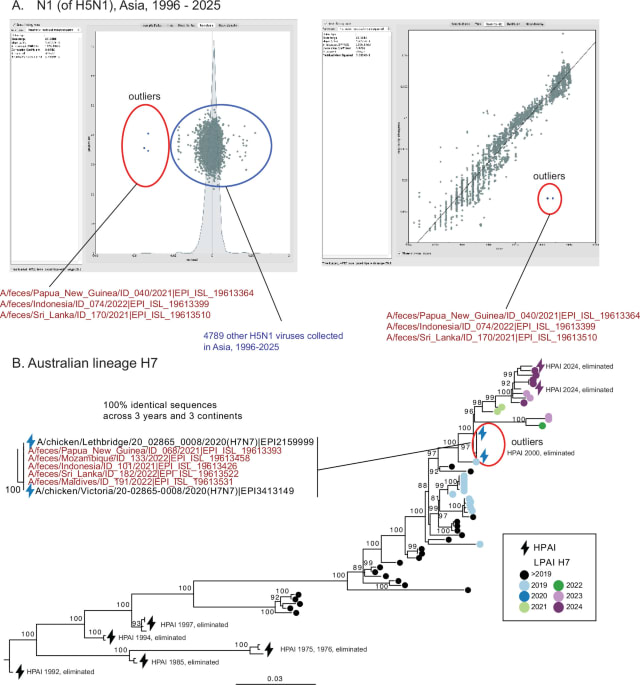
A holistic analysis of the NA sequences of HPAI H5N1 viruses collected in Asia since 1996 reveals the sequences in Wannigama et al. (2025) 1 to be clear outliers. A root-to –tip regression and scatterplot of residuals obtained from aTempEst 5 analysis (Fig. 1A ) clearly demonstrates that the NA sequences A/feces/Papua_New_Guinea/ID_040/2021 (EPI_ISL_19613364), A/feces/Indonesia/ID_074/2022 (EPI_ISL_19613399), A/feces/Sri_Lanka/ID_170/2021 (EPI_ISL_19613510) are outliers, indicative of improbable evolutionary stasis.
A TempEst residuals and root-to-tip regression analyses for a maximum likelihood phylogeny using 4792 NA sequences of H5N1 viruses collected in Asia between 1996 and 2025 from the GISAID EpiFlu database (accessed 5 July 2025). Sequences generated from Wannigama et al. 2025 are highlighted with a red oval. B Maximum likelihood tree of HA sequences in GISAID of Australian lineage H7 viruses. Tips are coloured by year, demonstrating accrued mutations and diversity over time within Australia. Mutation events to HPAI and subsequent eradication indicated by lightning bolt. Five sequences from Wannigama et al. (2025) are 100% similar to an eradicated HPAI H7 strain from 2020. This is in contrast to evolution and genetic diversity in sequences from the same locations in Australia, but across multiple years.
Construction of phylogenetic trees using these data reveals repeated examples of clades comprising numerous sequences from Wannigama et al. (2025) which are 100% identical to those from sequence databases (here GISAID EpiFlu; https://gisaid.org/ ). For example, Wannigama et al. (2025) 1 have generated HPAI H7 HA sequences from five countries (Papua New Guinea, Indonesia, Sri Lanka, Maldives and Mozambique) in 2021 or 2022, all of which are 100% identical to HA sequences of an eradicated HPAI H7 virus from Australia (A/chicken/Victoria/20-02865-0008/2020(H7N7)) (EPI3413151) (Fig. 1B ). Intensive and subsequence surveillance efforts in Australia confirmed elimination of this virus in 2020 with no spillover into wild birds 6 , 7 , 8 , and therefore it is inconceivable that a virus with 100% similarity would occur on different continents two years later. Similarly, it is implausible that sequences generated in this study from Yemen, the Maldives, Somalia and Papua New Guinea (EPI3724183, see Table S2 ) fall into a clade of HPAI H5N1 2.3.4.4b circulating in North America, and further, are 100% identical to each other, as welll as sequences from North America ( e.g . A/Canada goose/New York/NYCVH-23-453/2023(H5N1); EPI3262255). Given that avian influenza viruses have such high rates of evolutionary change, it is high unlikely that these viruses were spread by migrating birds between these locations without accruing a single mutation.
This problem of identical sequences across space and time is widespread in this study. For example, a BLAST search found that all sequences from Papua New Guinea (PNG)(n = 66) had matching HA and NA gene segments with 100% nucleotide identity and length to sequences previously uploaded to GISAID (Table 1 , Table S1 , S2 ). Of these, six NA sequences are identical to sequences deposited in GISAID with collection dates spanning 2004-2018 (the samples from Wannigama et al. (2025) 1 were collected from 2021-2023). Some of these are N1 sequences, which as demonstrated above, are clear outliers in molecular clock analysis. Fourty seven (47) of 66 sequences from PNG are 100% identical to other sequences from Wannigama et al. (2025) 1 , and often from numerous countries and years. In an extreme case, A/feces/Papua New Guinea/ID_043_2023(H5N1) (EPI13724183) is 100% identical to seven other sequences generated in this study (Yemen, Somalia, Maldives). This same sequence is also 100% identical to two sequences from North America (Table S2 ). Nine sequences from PNG are 100% identical to those from distant flyways which PNG does not fall within [African or North American flyways]. This apparent reservoir of genetic stasis in PNG is inconsistent with the global understanding of avian influenza (Table 1 ).
Further to issues around apparent evolutionary stasis raised above, is the erroneous assignment of avian H3 viruses to human seasonal-influenza specific clades using NextClade 9 . BLAST analysis of the H3 HA sequences generated confirms that the closest homology is to avian influenza viruses (Table S3 ). As avian H3 sequence do not have associated genetic clades, clade assignment tools 9 should have consistently resulted in “unassigned” clades (as demonstrated in Table S3 ). Rather, the H3 sequences generated in this study were assigned to human-specific clades 1 , including clade 3 C (circulating prior to 2015), 3 C.3a (2014–2016), and 3 C.3a1 (2018–2020), all of which are unrelated to avian viruses 10 .
Beyond data issues, no animal ethics or sample collection or movement/export/import permits 11 , 12 , 13 are listed in this study. Such permits are essential as all countries from which samples have been collected fall under the Convention on International Trade in Endangered Species (CITES) regulations 11 , with six countries also being signatories to the Convention of Biodiversity Nagoya Protocol 12 . Some genomic material and specimens for scientific exchange may be exempt from CITES permits, but require laboratories to be registered and proof of granted exemption is required 11 . Nagoya permits, on the other hand, require Prior Informed Consent (PIC) from the provider country for access to genetic resources, including RNA 12 . Overall, there were no acknowledgements provided that sample collections were exempt from national authorisations from the different countries regardless of their collection in non-protected areas.
There are significant real-world consequences to publishing erroneous data in Nature Communications and public repositories. The risk of incorporating and use of these problematic sequences from public repositories is high. Indeed, they have already been included in the Nextstrain avian-flu project ( https://nextstrain.org/avian-flu/h5n1/ha/all-time?d=tree,entropy&p=full)(23/07/2025 ) and are thus already visible to the global community and are hampering genetic assessments. Inclusion of erroneous sequences can interfere with appropriate strain selection for zoonotic candidate vaccine viruses (H5, H7, H9). Australia’s status as free of avian influenza could be called into question if viruses similar to the 2020 outbreak appear to be circulating in wild birds, raising questions about whether the virus was successfully eradicated.
In conclusion, we have identified fundamental issues in the genetic data and resulting conclusions presented by Wannigama et al. (2025) 1 , which require urgent re-evaluation. To maintain the integrity of global influenza surveillance, we further recommend the sequences generated in this study be verified and potentially withdrawn.
Wannigama, D. L. et al. Surveillance of avian influenza through bird guano in remote regions of the global south to uncover transmission dynamics. Nat. Commun. 16 , 4900, https://doi.org/10.1038/s41467-025-59322-z (2025).
Article CAS PubMed PubMed Central Google Scholar
Chen, R. & Holmes, E. C. Avian influenza virus exhibits rapid evolutionary dynamics. Mol. Biol. Evol. 23 , 2336–2341 (2003).
Worobey, M., Han, G. Z. & Rambaut, A. A synchronized global sweep of the internal genes of modern avian influenza virus. Nature 508 , 254–257 (2014).
Pauly, M. D., Procario, M. C. & Lauring, A. S. A novel twelve class fluctuation test reveals higher than expected mutation rates for influenza A viruses. eLife 9 , 26437 (2017).
Rambaut, A., Lam, T. T., Carvalho, L. M. & Pybus, O. G. Exploring the temporal structure of heterochronous sequences using TempEst (formerly Path-O-Gen). Virus Evol. 2 , vew007, https://doi.org/10.1093/ve/vew007 (2016).
Article PubMed PubMed Central Google Scholar
Bisset, A. T. & Hoyne, G. F. An outbreak of highly pathogenic avian influenza (H7N7) in Australia and the potential for novel influenza A viruses to emerge. Microorganisms 9 , 1639, https://doi.org/10.3390/microorganisms9081639 (2021).
Premier of Victoria. Victorians Achieve National Freedom From Avian Influenza. https://www.premier.vic.gov.au/victorians-achieve-national-freedom-avian-influenza (2021). Accessed 21/07/2025
Wildlife Health Australia. Wild Bird Surveillance. https://wildlifehealthaustralia.com.au/Our-Work/Surveillance/Wild-Bird-Surveillance (2025). Accessed 21/07/2025
Nextclade, Nextclade v3.15.3 Clade assignment, mutation calling, and sequence quality checks https://clades.nextstrain.org/ (2025). Accessed 21/07/2025
Nextstrain. Real-time tracking of influenza A/H3N2 evolution. https://nextstrain.org/seasonal-flu/h3n2/ha/12y?c=clade_membership (2025). Accessed 21/07/2025
Convention on International Trade in Endangered Species of Wild Fauna and Flora, (1973). https://cites.org/eng/disc/text.php#VIII
Convention on Biological Diversity United Nations. Nagoya protocol on access to genetic resources and the fair and equitable sharing of benefits arising from their utilization to the convention on biological diversity. 234 (2011) ELI: http://data.europa.eu/eli/agree_prot/2014/283/oj
World Organisation for Animal Health. Chapter 1.1.3. Transport of Biological Materials. OIE/WOAH Terrestrial Manual 23-47 (2018).
We gratefully acknowledge all data contributors for generating the genetic sequence and metadata and sharing via the GISAID Initiative. This research was supported [in part] by the Intramural Research Program of the National Institutes of Health (NIH). The contributions of the NIH author(s) are considered Works of the United States Government. The findings and conclusions presented in this paper are those of the author(s) and do not necessarily reflect the views of the NIH or the U.S. Department of Health and Human Services.
Department of Microbiology and Immunology, The University of Melbourne, Peter Doherty Institute for Infection and Immunity, Melbourne, VIC, Australia
Department of Virology, Animal and Plant Health Agency (APHA-Weybridge), Woodham Lane, Addlestone, Surrey, UK
WOAH/FAO International Reference Laboratory for Avian Influenza, Newcastle disease virus and Swine Influenza, Animal and Plant Health Agency-Weybridge, Woodham Lane, New Haw, Addlestone, Surrey, UK
Division of Comparative Biomedical Sciences, Istituto Zooprofilattico Sperimentale delle Venezie, Legnaro, Padua, Italy
School of Veterinary Science, University of Queensland, Brisbane, QLD, Australia
The Pirbright Institute, Pirbright, UK
Virology Unit, WHO H5 Reference Laboratory, Institut Pasteur du Cambodge, Phnom Penh, Cambodia
Worldwide Influenza Centre, WHOCC for influenza reference and research, Francis Crick Institute, London and Royal Veterinary College, University of London, London, UK
Division of Intramural Research, National Library of Medicine, National Institutes of Health, Bethesda, MD, USA
Asia Pacific Veterinary Information Services, Montmorency, VIC, Australia
Poultry Diagnostic and Research Center, College of Veterinary Medicine, The University of Georgia, Athens, GA, USA
Karen C. Drayer Wildlife Health Center, School of Veterinary Medicine, University of California, Davis, CA, USA
Commonwealth Scientific and Industrial Research Organisation (CSIRO), Australian Centre for Disease Preparedness, Geelong, VIC, Australia
Search author on: PubMed Google Scholar
All authors contributed to the writing and editing of the document and approved the final version.
The authors declare no competing interests.
Nature Communications thanks the anonymous reviewer(s) for their contribution to the peer review of this work.
Publisher’s note Springer Nature remains neutral with regard to jurisdictional claims in published maps and institutional affiliations.
Open Access This article is licensed under a Creative Commons Attribution 4.0 International License, which permits use, sharing, adaptation, distribution and reproduction in any medium or format, as long as you give appropriate credit to the original author(s) and the source, provide a link to the Creative Commons licence, and indicate if changes were made. The images or other third party material in this article are included in the article’s Creative Commons licence, unless indicated otherwise in a credit line to the material. If material is not included in the article’s Creative Commons licence and your intended use is not permitted by statutory regulation or exceeds the permitted use, you will need to obtain permission directly from the copyright holder. To view a copy of this licence, visit http://creativecommons.org/licenses/by/4.0/ .
Wille, M., Banyard, A.C., Bonfante, F. et al. Evidence of widespread sequencing errors in global avian influenza study. Nat Commun 17 , 11335 (2026). https://doi.org/10.1038/s41467-026-78539-0
Version of record : 02 November 2026
DOI : https://doi.org/10.1038/s41467-026-78539-0
Anyone you share the following link with will be able to read this content:
Sorry, a shareable link is not currently available for this article.
Provided by the Springer Nature SharedIt content-sharing initiative
Nature Communications ( Nat Commun )
© 2026 Springer Nature Limited



Loading comments…